





Overhead cranes are widely used in steel, mechanical engineering, automotive, cement, and other heavy industrial facilities to transport heavy materials. Because both the crane and its load continuously move throughout the facility, the hazardous zone also changes accordingly and can appear in different locations.
AI Cameras for overhead crane safety monitoring can help detect people beneath suspended loads or entering hazardous zones in real time. The system uses Computer Vision to identify people, determine their position relative to the load, and trigger alerts when a potential risk is detected.
Unlike conventional surveillance cameras that simply record footage, AI Cameras can actively participate in risk detection. This approach is particularly suitable for areas where hazardous zones continuously change as the overhead crane moves.
What Are the Common Safety Risks When Operating Overhead Cranes?
During operation, overhead cranes may transport loads weighing several tons in different directions across a facility. Loads can change position, swing while moving, or obstruct visibility between the crane operator and the area below.
Hazardous situations can occur when workers stand or walk beneath suspended loads, move too close to a moving load, or enter areas that the crane operator cannot see clearly. When the distance between a person and a load changes rapidly, the available time to recognize the danger and respond also becomes shorter.
At a steel processing facility where EYEFIRE implemented its solution, heavy steel coils were continuously transported horizontally and vertically throughout the production area. Detecting workers beneath the crane or entering hazardous zones around the steel coils was therefore an important requirement for the safety system.
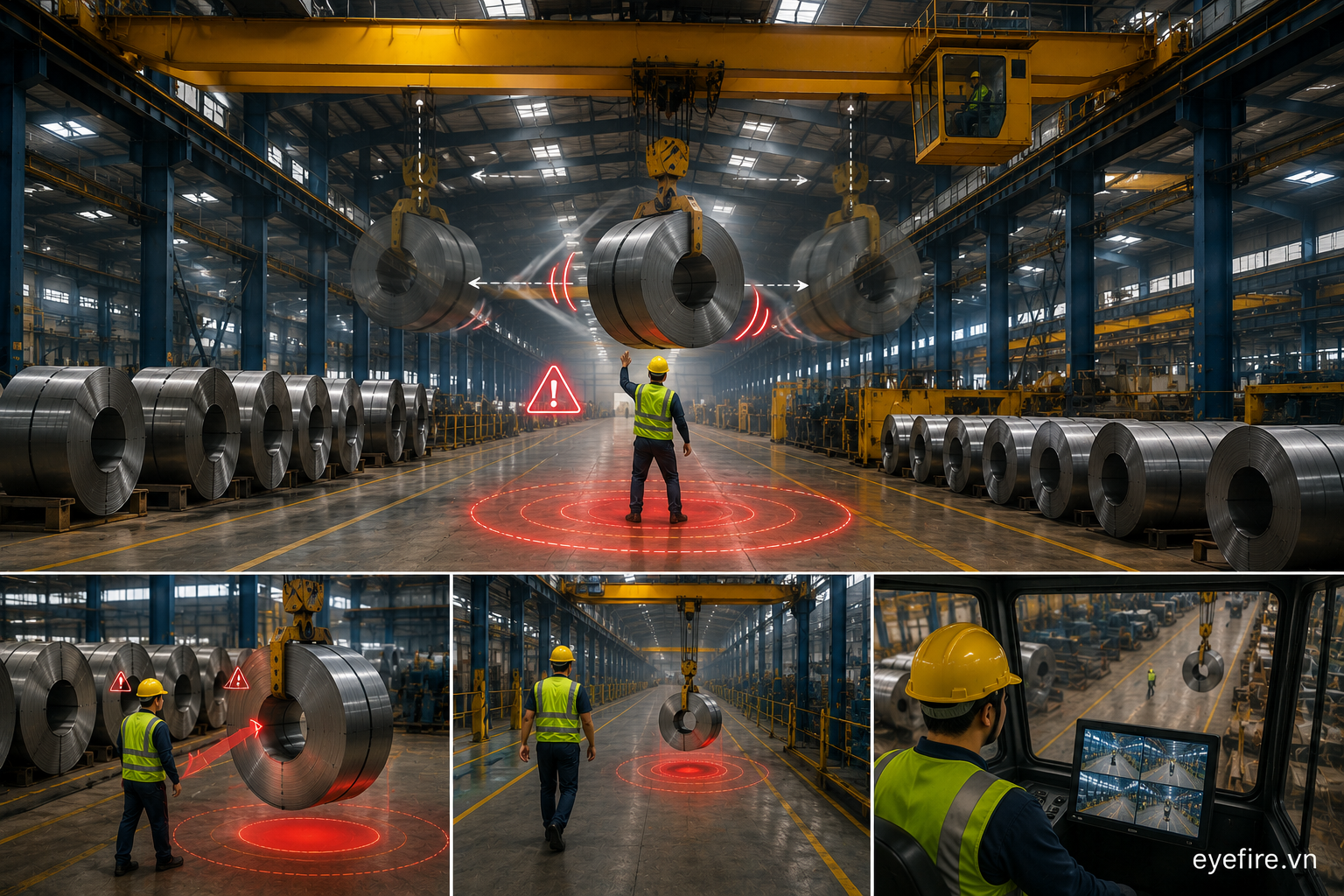
What Is a Dynamic Hazardous Zone Around an Overhead Crane?
A dynamic hazardous zone is an area of risk whose position changes according to the movement of the overhead crane and its load. As the load moves, the area that needs to be monitored moves with it rather than remaining fixed at one location on the factory floor.
This is what makes overhead crane safety different from many types of stationary industrial equipment. With a press machine or machining equipment, businesses can define a hazardous zone in advance and use barriers, light curtains, or sensors to control access.
With an overhead crane, a location that is safe at one moment can become hazardous only a few seconds later when the load moves into that area. The monitoring system therefore needs to determine not only whether a person is present in the facility, but also where that person is in relation to the current position of the load.
Why Does Traditional Overhead Crane Safety Monitoring Still Have Limitations?
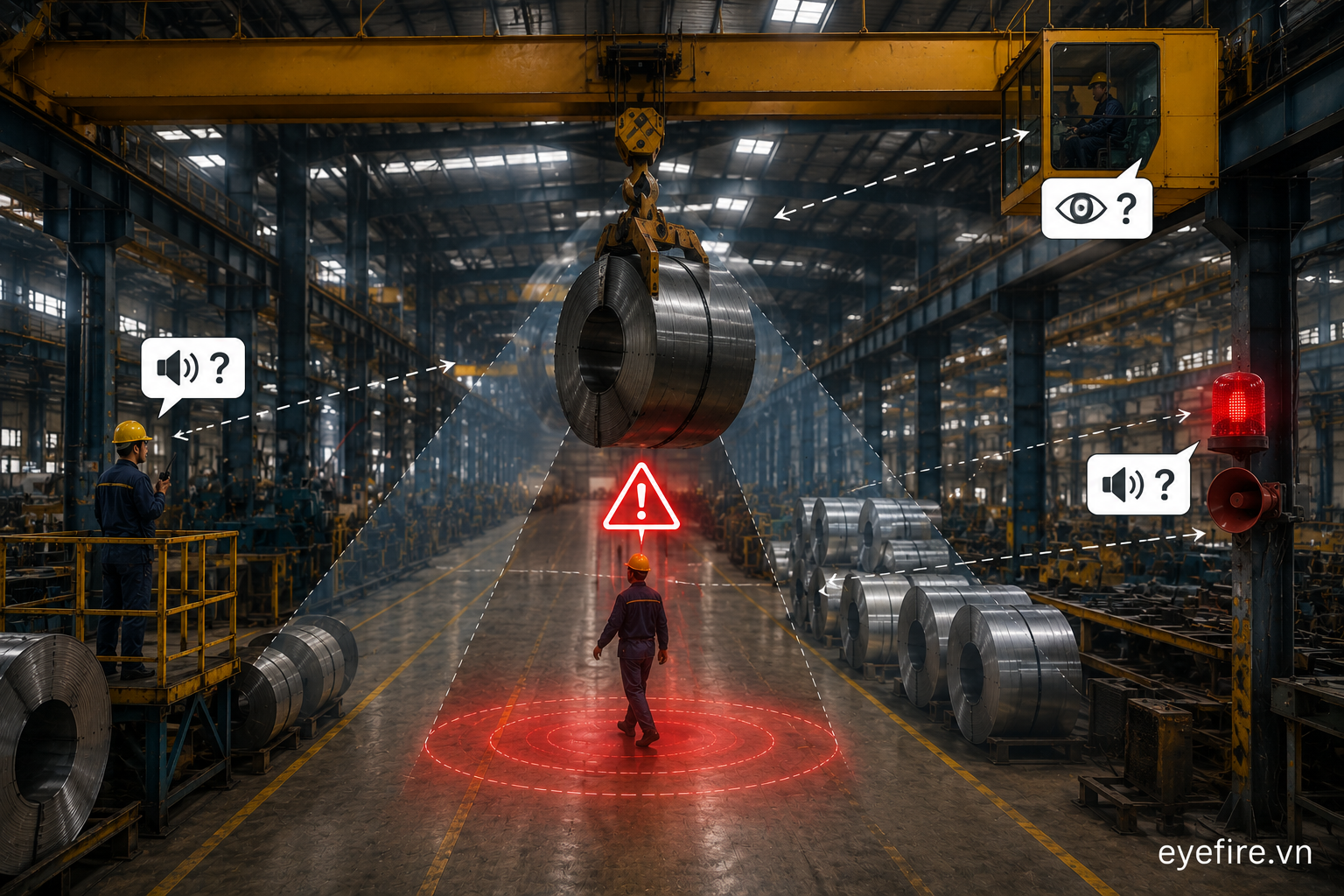
In many factories, overhead crane safety still depends on the experience of crane operators, personnel observing from the factory floor, radio communication, warning alarms, and other safety devices. These measures remain necessary, but their ability to detect hazards may depend heavily on human visibility and concentration.
Large loads, factory structures, and production equipment can also create blind spots. As a result, crane operators may not always be able to see the entire area beneath and around the suspended load.
Fixed sensors can provide an additional layer of protection, but they are generally designed to monitor a specific location or predefined area. When the crane and its load continuously change position, monitoring the entire operating area becomes more complex.
How Does an AI Camera Detect People in an Overhead Crane Hazardous Zone?
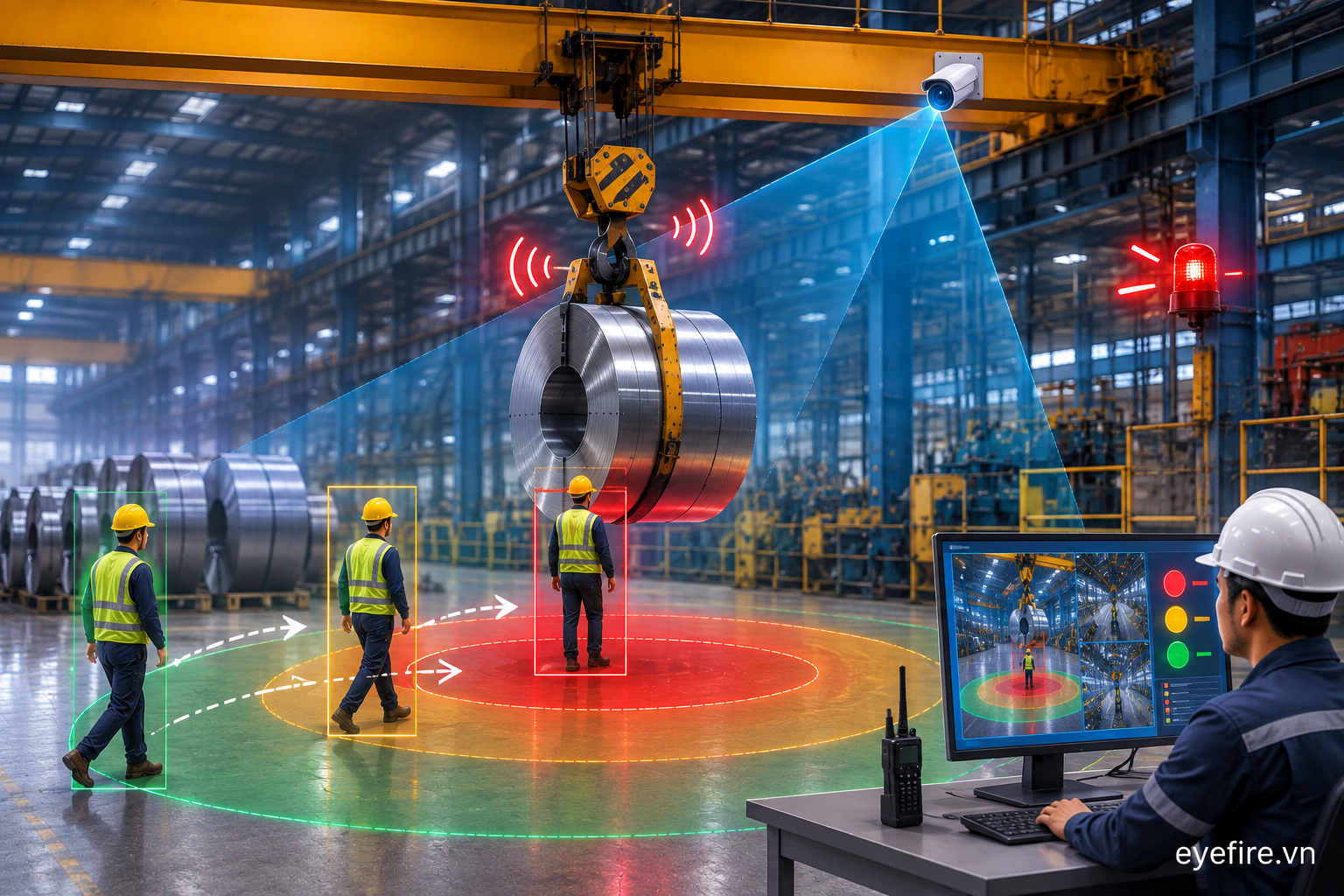
AI Cameras detect people in hazardous zones by analyzing images in real time, identifying people, and determining their position relative to the warning zone around the load. When a person enters an area defined as hazardous, the system can automatically trigger an alert.
Cameras can be installed directly on the overhead crane so that their field of view moves together with the equipment. Camera footage is transmitted to an AI processing system, where Computer Vision models continuously analyze the presence and location of people.
In the solution implemented by EYEFIRE at a steel processing facility, AI automatically creates hazardous warning zones around steel coils and divides them into multiple alert levels. The cameras are installed on the overhead crane, allowing them to move together with the equipment during operation.
As a result, the system does not simply answer the question, “Is there a person in the factory?” More importantly, it determines “Is anyone currently inside the hazardous zone around the load?”
Can AI Cameras Track Hazardous Zones While the Overhead Crane Is Moving?
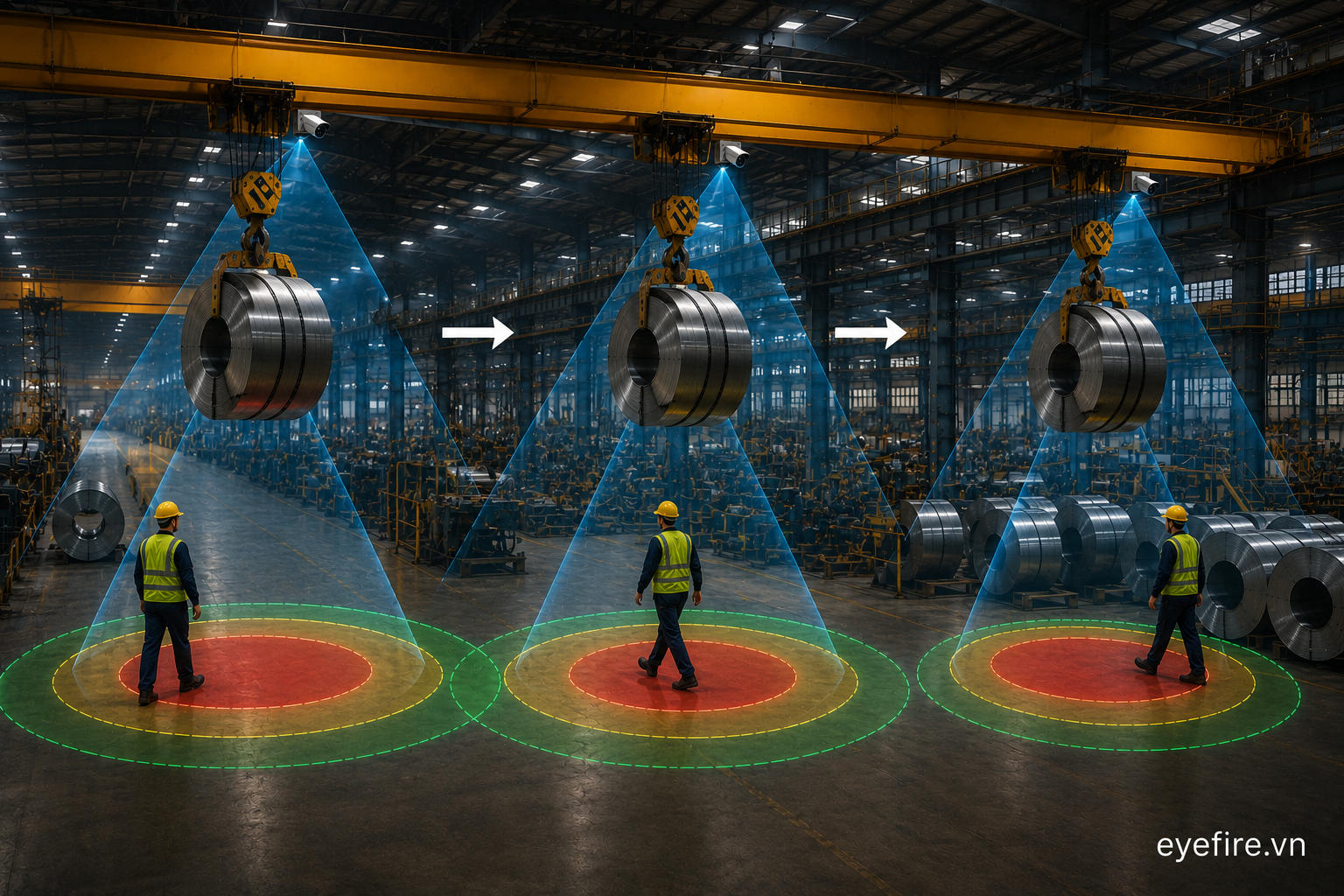
Yes. When cameras are appropriately positioned and move together with the overhead crane, the monitored zone can be defined according to the actual position of the equipment and its load rather than remaining fixed at a specific location on the factory floor.
As the overhead crane changes position, the system continues analyzing images to detect people within the monitored area. This is how AI Cameras can support dynamic hazardous zone monitoring during overhead crane operations.
This approach is particularly useful in facilities where overhead cranes operate across large areas. Instead of creating numerous fixed warning zones, the system can monitor risks associated with the actual position of the moving load.
How Can AI Cameras Reduce Blind Spots Beneath Overhead Cranes?
A single camera may not always be sufficient to observe the entire area beneath a large overhead crane. The load itself, machinery, or structural elements within the facility may obstruct people from view and create blind spots.
One approach is to install multiple cameras facing different directions to expand the overall field of view. In an actual EYEFIRE deployment, the system uses four AI Cameras positioned in four directions beneath the overhead crane, helping continuously monitor the area around the load and reduce blind spots during operation.
Because the cameras are installed directly on the overhead crane, the monitoring system moves together with the equipment. This differs from relying solely on fixed surveillance cameras to monitor the factory floor.
How Does an AI Camera Issue Alerts When Someone Enters a Hazardous Zone?
Not every position around a suspended load represents the same level of risk. A person approaching a load may require a different warning from someone standing directly within a high-risk area.
AI Camera systems can define multiple levels of warning zones around the load. As a person moves from a safe zone into a warning or hazardous zone, the system can generate an alert corresponding to the level of risk.
In the system implemented by EYEFIRE, hazardous zones around steel coils are divided into multiple levels to support appropriate responses for different situations. This approach allows the system not only to detect people but also to determine the level of attention required based on their position.
Can AI Cameras Be Integrated With an Overhead Crane Control System?
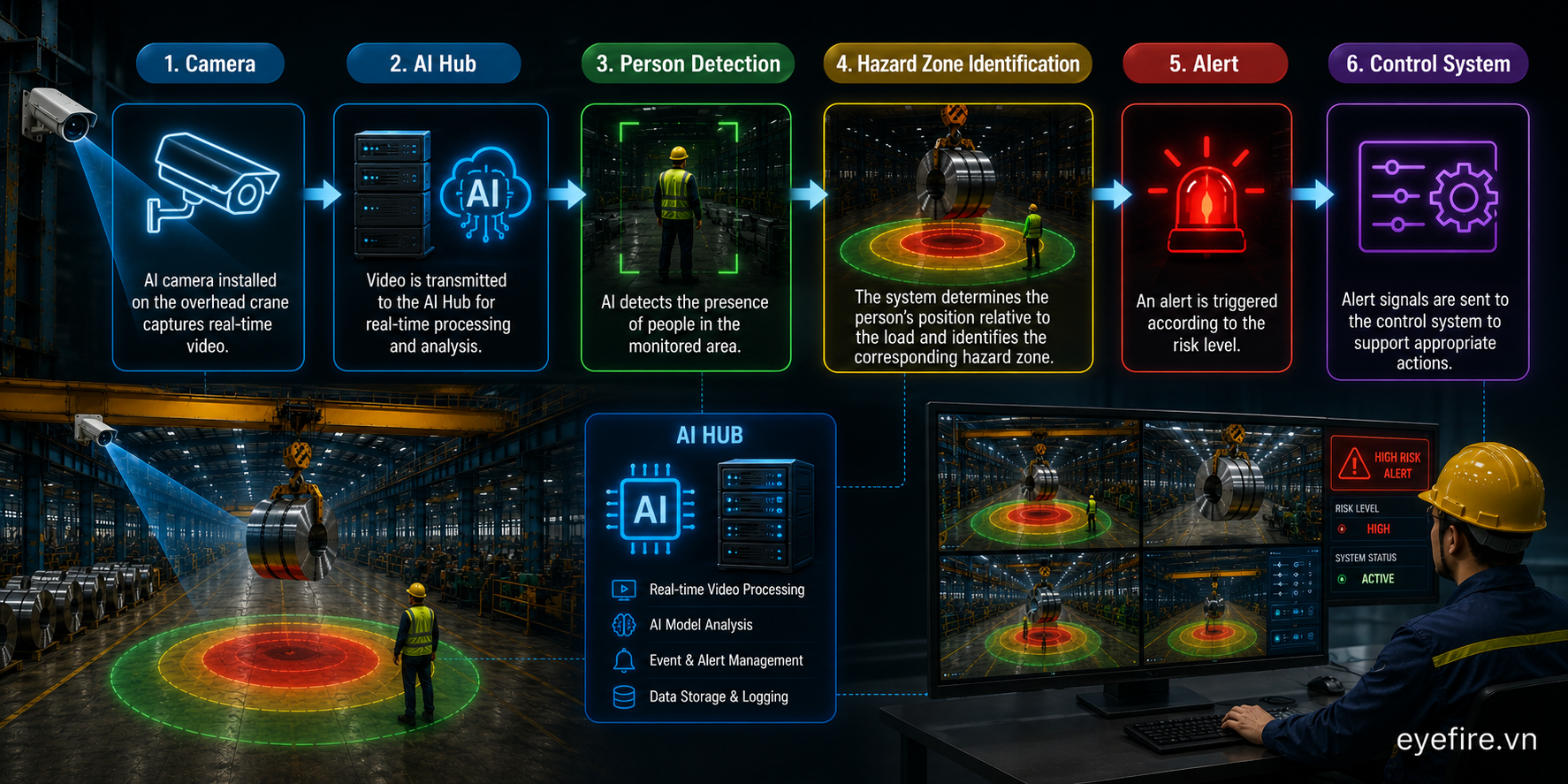
The camera serves as the image acquisition layer, while analysis is performed by the AI processing system. Images can be transmitted to an AI Hub, where the AI Engine detects people, identifies hazardous zones, and generates warning signals.
Depending on the system design and the factory's safety requirements, warning signals can be sent to the control system to support appropriate actions. Integration needs to be designed and evaluated according to the existing control system, operational requirements, and specific safety standards of each facility.
The processing flow can be illustrated as follows:
Camera → AI Hub → Person Detection → Hazardous Zone Identification → Alert → Control System
As a result, AI Cameras do more than simply record footage for review after an incident. The system can become an active detection layer that helps factories identify risks as soon as they emerge.
Do AI Cameras Replace Existing Overhead Crane Safety Devices?
AI Cameras should not be considered a complete replacement for existing safety devices and procedures. For overhead cranes and other heavy lifting equipment, a multi-layered safety approach remains important.
Measures such as operating procedures, safety zoning, audible warnings, travel limits, and control systems continue to serve their own functions. AI Cameras add the ability to identify people and analyze their position relative to the actual hazardous zone.
By combining these layers of protection, businesses can reduce their dependence on a person having to observe the entire area at all times. At the same time, the system gains an additional capability to detect situations that fixed monitoring methods may find difficult to identify.
How Can AI Cameras Help Manage Near-Misses Beneath Overhead Cranes?
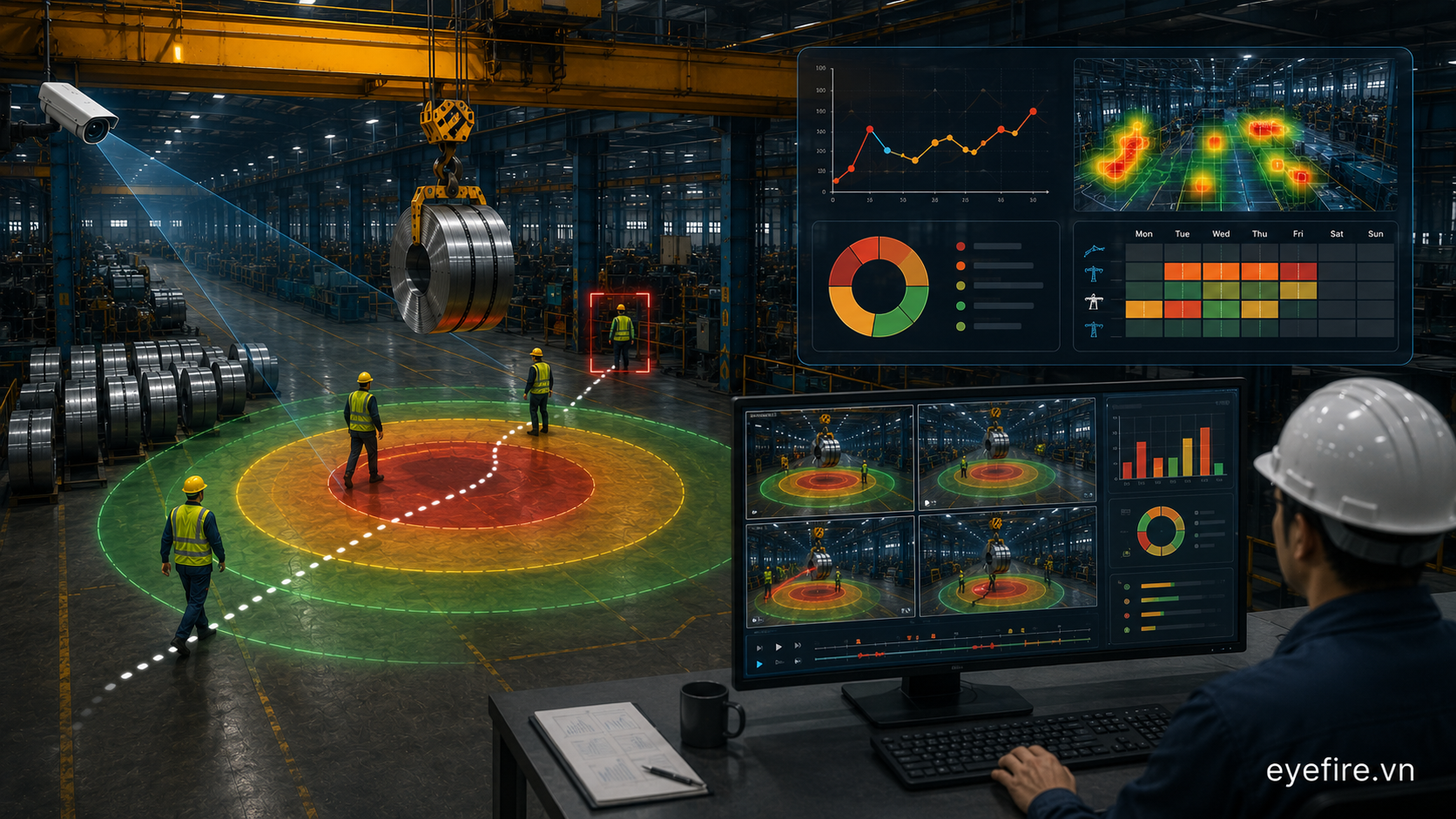
The value of AI Cameras goes beyond real-time alerts. Detected events can be stored so that HSE teams can review situations in which people frequently approach or enter hazardous zones.
When this data is aggregated over time, factories can identify areas where warnings frequently occur, periods with higher numbers of hazardous interactions, and situations that repeatedly happen. This provides valuable data for analyzing near-misses and identifying their causes before a serious incident occurs.
If alerts repeatedly occur in the same location, the problem may not simply be related to worker behavior. The layout of pedestrian routes, lifting procedures, or the movement patterns of people and equipment may also need to be reviewed.
How Has EYEFIRE Implemented AI Camera Monitoring for Overhead Crane Safety?
At a facility specializing in steel coil processing, EYEFIRE implemented an AI Camera system for overhead crane safety monitoring to detect people in areas beneath suspended loads. Four cameras were positioned in four directions and moved together with the overhead crane, while AI automatically created warning zones around the steel coils.
Images were transmitted to the AI Hub for real-time analysis. When a person was detected within a hazardous zone, the system generated alerts according to the defined risk level and could send signals to the control system based on the deployment configuration.
The solution enables continuous monitoring of the area beneath the overhead crane, reduces dependence on manual supervision, and supports faster responses when hazards are detected. This model can also be considered for similar lifting equipment in factories, ports, warehouses, logistics facilities, and other industrial environments.
When Should Businesses Consider AI Cameras for Overhead Crane Safety Monitoring?
AI Cameras are worth considering when overhead cranes operate across large areas, suspended loads frequently move through locations where people work, or the facility contains multiple blind spots. They are also suitable for businesses seeking to add real-time person detection capabilities to their existing safety systems.
Before deployment, businesses should assess the crane's operating range, load types, worker locations, blind spots, lighting conditions, and existing control systems. These factors determine the appropriate number of cameras, installation positions, warning zones, and integration approach.
EYEFIRE can assess actual operating environments and develop AI Camera solutions tailored to the specific characteristics of each facility. The objective is not only to detect people beneath overhead cranes but also to provide an additional layer of proactive monitoring throughout lifting operations.