





When implementing safety solutions for forklifts, many businesses face the same question: should they invest in an AI Camera system or use sensors mounted directly on forklifts? Both solutions aim to reduce collisions and improve workplace safety, but their operating principles, application scope, and long-term value are very different.
There is no single solution that fits every situation. What matters is that businesses understand what each technology can solve and which option is better suited to their specific operating environment.
Why Forklifts Need More Than One Warning Device
Forklift accidents rarely result from a single cause. In reality, an incident is often the result of multiple factors occurring at the same time, such as blind spots, pedestrians appearing unexpectedly, goods blocking visibility, busy intersections, or operators being distracted during work.
If a system only detects the distance between a forklift and an obstacle, the business still does not have enough information to assess the actual level of danger. What managers really need is not only to know that there is an object in front of the forklift, but also whether that object is a person or a pallet, whether the forklift is traveling in the correct lane, whether a worker has entered a hazardous area, and how the entire event unfolded.
That is why modern safety solutions no longer focus solely on “detecting obstacles.” They are moving toward “understanding the context” of the entire working environment.
How Do Forklift-Mounted Sensors Work?
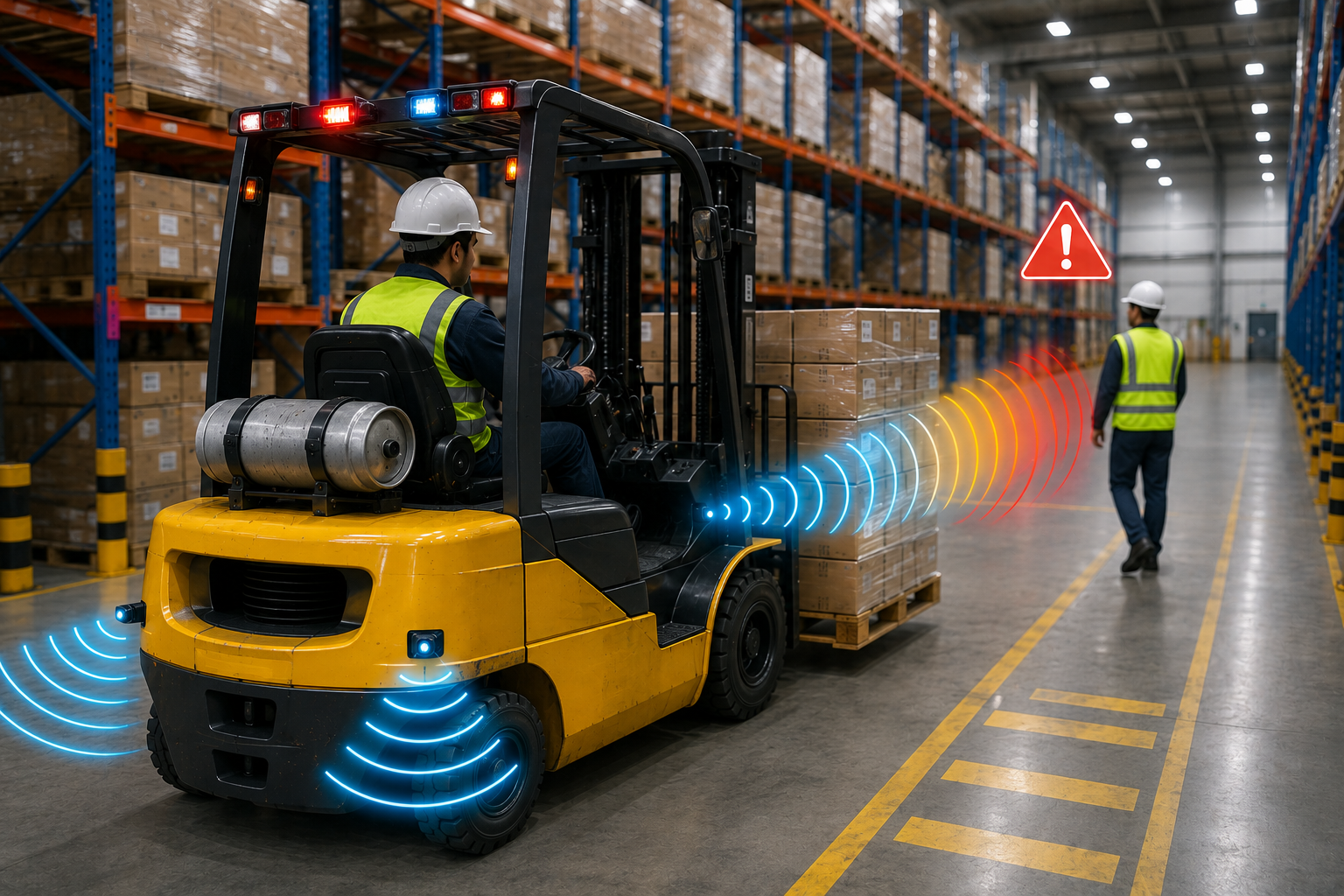
Sensor systems such as ultrasonic sensors, radar, or LiDAR are usually mounted directly on forklifts to measure the distance between the vehicle and surrounding objects. When an obstacle is detected within a hazardous zone, the system emits an audible signal or warning to prompt the operator to slow down or stop.
The biggest advantage of sensors is their fast response time and stable performance in close-range distance measurement scenarios. Some systems can also connect to the controller to automatically limit speed or activate braking under certain conditions.
However, sensors only know that there is an object ahead. They cannot distinguish whether it is a worker, another forklift, a pallet, or a fixed rack column. They also do not fully record the context of the event for later analysis by the business.
AI Cameras See More Than Distance
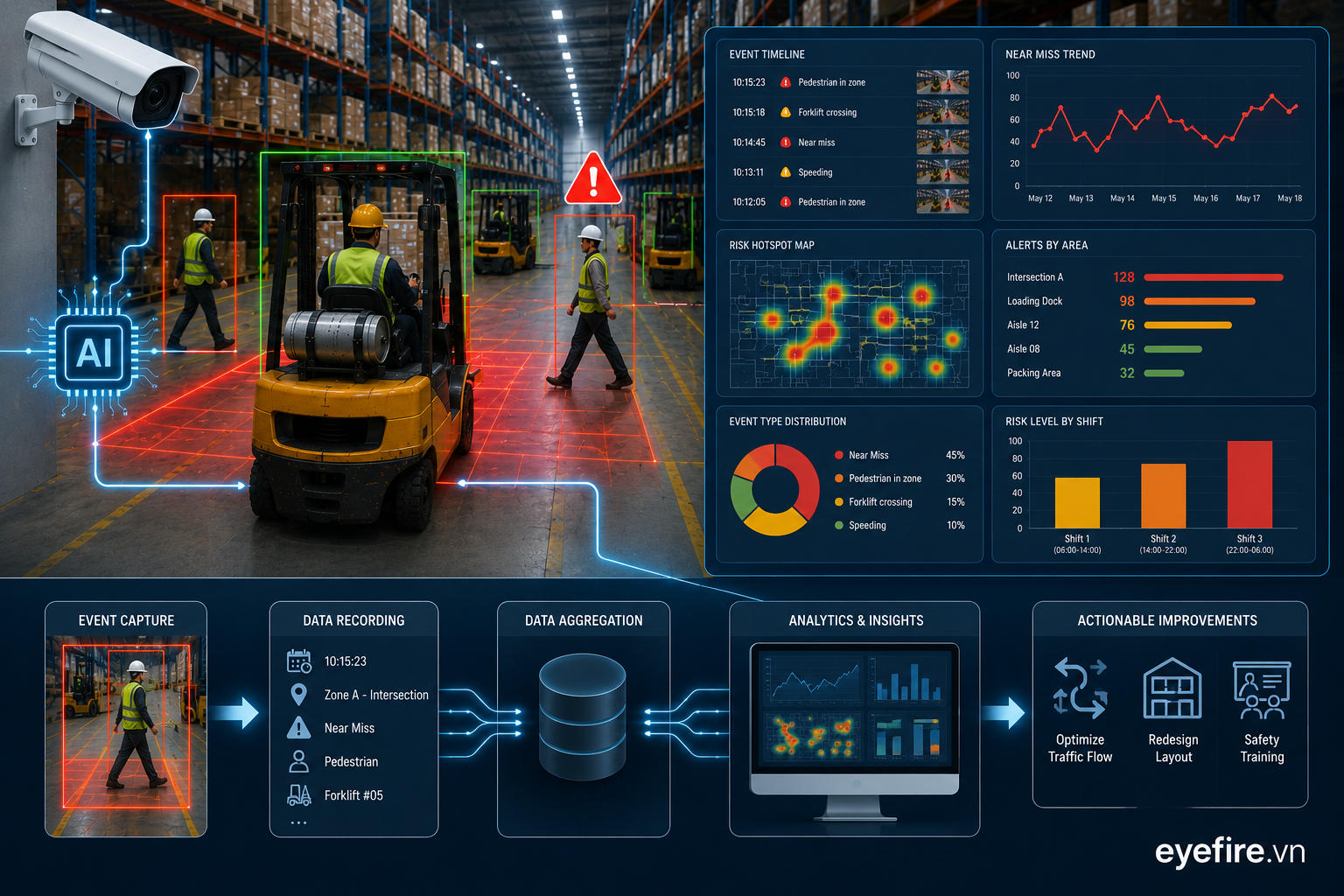
Unlike sensors, AI Cameras analyze visual data directly from camera footage using Computer Vision technology. Instead of merely detecting the presence of an obstacle, AI can identify people, forklifts, pallets, vehicles, hazardous zones, or abnormal behaviors taking place in the working environment.
For example, AI can detect when a worker is entering a forklift operating zone, identify a forklift traveling in the wrong lane, recognize multiple forklifts approaching the same intersection, or issue alerts when workers are not wearing proper PPE in areas where vehicles are operating.
This allows businesses not only to know that “there is a collision risk,” but also to understand what is causing that risk.
AI Cameras Do More Than Send Alerts - They Generate Operational Data
One of the biggest differences between AI Cameras and sensors lies in their ability to generate data.
After each event, an AI Camera does not only save the video. It can also record the time, location, event type, related objects, and other important details. Over time, businesses can analyze which areas frequently experience near misses, which intersections generate the most alerts, or which shifts carry higher operational risks.
This data helps factories go beyond handling individual incidents. It allows them to improve operating procedures, adjust traffic flows, redesign layouts, and enhance safety training based on real evidence.
This is something traditional sensor systems can hardly provide.
Scalability Is Also an Important Difference
In most cases, sensors are designed to solve a specific problem, such as obstacle warning or distance measurement. If a business wants to add more functions, it often has to install additional specialized devices.
AI Cameras, on the other hand, can scale flexibly on the same platform. After being deployed for forklift safety, the system can continue to support PPE monitoring, restricted-area intrusion detection, people counting, pallet counting, warehouse space utilization analysis, QR Code or Barcode recognition, conveyor monitoring, and many other applications without replacing the entire camera infrastructure.
As a result, the initial investment does not serve only one single need. It can create long-term value for multiple departments across the business.
Which Solution Should Businesses Choose?
If the main goal is close-range distance warning or supporting drivers in simple maneuvers, sensors remain an effective and cost-efficient option.
However, if the business wants to build a system that can recognize context, prevent accidents in real time, store data for analysis, and expand into other operational use cases, AI Cameras can deliver greater long-term value.
In reality, many modern factories do not treat AI Cameras and sensors as mutually exclusive solutions. Instead, they combine both. Sensors handle fast distance measurement, while AI Cameras provide scene understanding, behavior analysis, and management data. This combination helps businesses build multiple layers of protection instead of relying on a single technology.
Conclusion
No technology can completely eliminate risk in manufacturing and warehousing environments. What matters is choosing a solution that matches the company’s management goals and future scalability needs.
While sensors help forklifts respond to obstacles, AI Cameras help businesses understand the full context of what is happening on-site. This is why more factories are beginning to view AI Cameras not only as a safety solution, but also as a data platform for intelligent operations. At EYEFIRE, AI Camera technology is developed in this direction, helping businesses reduce collision risks while also using visual data to optimize safety, operations, and production efficiency on a single platform.