


In factories, not all hazardous areas have the same location or boundaries. Some areas have relatively stable boundaries, such as the operating zones of stamping machines, cutting machines, or production lines. Meanwhile, other hazardous areas may change continuously as overhead cranes, suspended loads, or transport vehicles move.
This difference directly affects how businesses organize safety monitoring. Applying the same detection and alerting methods to every area may result in unnecessary alerts or missed hazardous situations.
With AI Camera technology, businesses can analyze video footage to detect people appearing in monitored zones and support early warnings. However, fixed and dynamic hazard zones require different approaches to camera placement, monitoring zone configuration, and alert conditions.
What Are Fixed and Dynamic Hazard Zones?
Fixed Hazard Zones
A fixed hazard zone is an area whose location or boundaries remain relatively stable during operations. These areas are typically associated with machinery, equipment, or production processes located in designated positions.
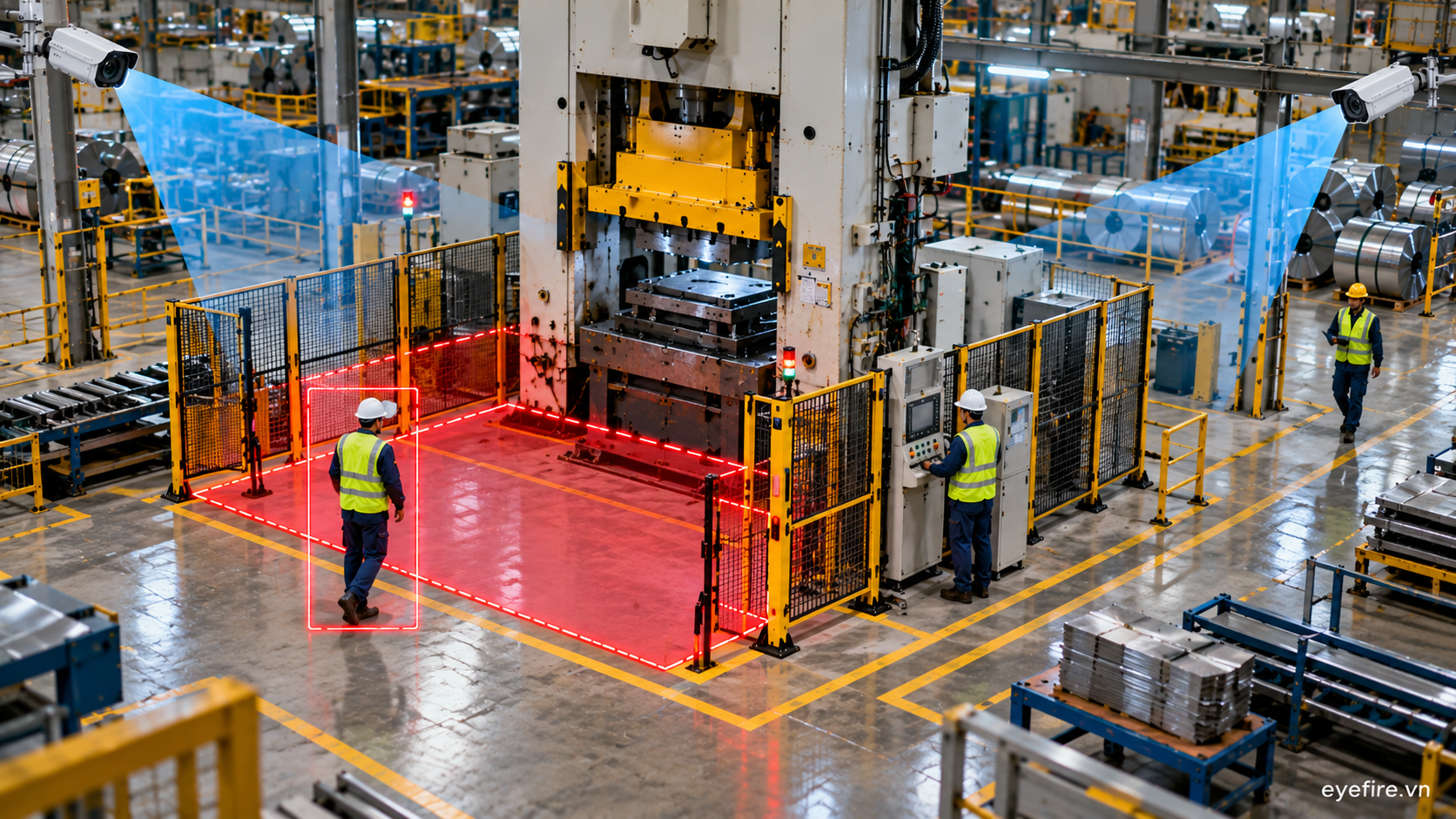
For example, the operating area of a stamping machine, the accessible zone around moving parts of a cutting machine, or a restricted area surrounding a production line can be identified in advance on a factory layout.
In these areas, risks often arise from equipment operation, mechanical movements, materials being processed, or people approaching unsafe locations.
For AI Camera systems, businesses can configure a monitoring zone within the camera image corresponding to the area that needs to be controlled. When a person is detected inside the configured zone, the system can record the event and generate an alert based on predefined conditions.
However, a zone with a fixed location does not necessarily have the same level of risk at all times. Machine operating status, maintenance procedures, and access permissions for different personnel groups may change the monitoring requirements.
Dynamic Hazard Zones
A dynamic hazard zone is an area whose location, boundaries, or risk level changes according to the movement of equipment, vehicles, or objects during operations.
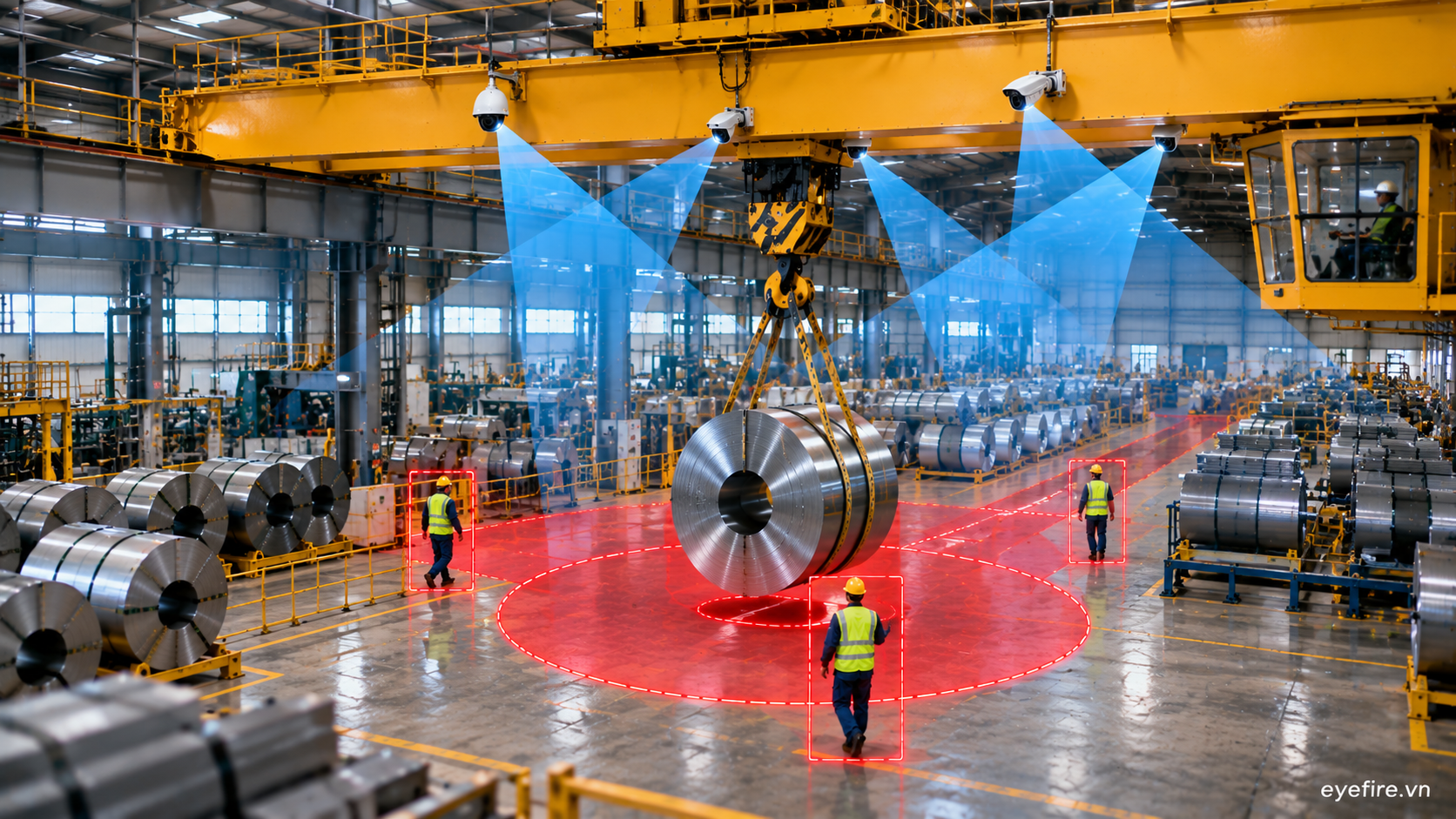
A typical example is the area beneath and around a load being lifted by an overhead crane. As the crane moves, the load changes position, meaning the area requiring particular attention also moves accordingly.
Similarly, a forklift traveling through a warehouse may create different hazardous situations depending on its direction of movement, speed, visibility, and the presence of pedestrians.
Unlike fixed hazard zones, configuring only one unchanging monitoring area within the camera image may not adequately reflect the hazardous situations that arise as equipment moves.
For these applications, AI Camera systems need to be designed to monitor conditions in ways that match actual movement patterns. Depending on the solution, monitoring may rely on cameras moving with equipment, multiple fixed cameras, or object detection and tracking models.
How Do AI Cameras Monitor Fixed Hazard Zones?
Defining the Area That Needs to Be Monitored
For fixed hazard zones, the first step is to identify the area that needs monitoring based on an on-site risk assessment.
Cameras are positioned to provide a clear view of the area, after which the AI system establishes a corresponding detection zone within the image. When a person appears in or enters the monitored zone, the system can identify the event according to configured rules.
For example, in a stamping machine area, an AI Camera can help detect a person entering a restricted access zone outside the protective guarding. When such an event occurs, the system sends an alert so that responsible personnel can investigate.
Monitoring zone configuration should consider camera angles, obstacles, the size of objects in the image, and locations where workers frequently move.
Importantly, a monitoring zone defined within a camera image must not automatically be treated as a technically validated safety boundary.
Configuring Alert Conditions According to Operating Procedures
Not every instance of someone entering an area constitutes a violation. Certain personnel may be authorized to access equipment for inspection, operation, or maintenance under established procedures.
Therefore, AI Camera systems should be configured according to actual monitoring requirements rather than simply generating an alert whenever a person is detected.
For example, businesses may establish different conditions for restricted access areas, areas requiring continuous monitoring, or periods when equipment is operating.
If machine status information is to be combined with video data, the system must have suitable integration capabilities, and its reliability must be evaluated. It should not be assumed that every AI Camera solution can automatically and accurately determine the operating status of machinery.
Managing False Alerts and Blind Spots
Even when the monitoring zone remains unchanged, detection performance is still affected by actual operating conditions.
Workers may be obscured by materials, stand near the boundary of a monitoring zone, or appear at viewing angles that make it difficult for the system to determine their position accurately. Changes in lighting, dust, and vibration can also affect image quality.
Businesses should therefore test the system under different operating scenarios to evaluate detection performance and adjust configurations before putting it into regular operation.
How Do AI Cameras Monitor Dynamic Hazard Zones?
Tracking Changes in the Location of Hazardous Areas
For dynamic hazard zones, the greater challenge is that the source of danger does not remain stationary.
During lifting operations, overhead cranes may move in multiple directions, suspended loads change position, and nearby workers may also move continuously.
If only a fixed monitoring zone is configured within the camera image, the system may not be able to monitor the entire relevant area as the suspended load changes position.
Businesses therefore need to select camera arrangements and analysis methods that match the movement characteristics of the equipment.
One approach is to use cameras that move together with the overhead crane to maintain visibility of areas associated with the load. Another approach is to install multiple fixed cameras at suitable locations and combine monitoring data according to the system design.
However, cameras moving with equipment do not automatically mean that the system can accurately identify the entire hazard zone. Effectiveness still depends on the field of view, load movement, occlusion, and the capabilities of the AI model.
Identifying the Relationship Between People and Moving Equipment
For dynamic hazard zones, detecting a person in the image is only the first step.
The system needs to help determine whether that person is present in a monitored area associated with equipment that is currently moving or operating.
For example, a worker standing near the travel path of an overhead crane does not necessarily face the same level of risk as someone standing directly beneath a suspended load. Assessing the situation depends on relative positions, movement direction, load dimensions, and other operating conditions.
Similarly, in a warehouse, the simultaneous presence of a person and a forklift in the same camera frame is not enough to confirm a collision risk. The system needs monitoring rules that reflect traffic patterns and the characteristics of the area.
Advanced capabilities such as spatial relationship analysis or motion prediction should only be considered features of a particular solution when they have been verified and tested in real-world conditions.
Ensuring Alerts Match Operating Speeds
When equipment or suspended loads are moving, the time required to detect an event and deliver an alert becomes particularly important.
An alert generated too late may no longer be sufficiently useful for on-site personnel to recognize and respond to a hazardous situation.
Therefore, in addition to detection accuracy, businesses need to evaluate the latency of the entire process, from the moment an event appears in the camera image to the moment a warning device or responsible person receives the information.
This requirement may make on-site processing architectures, such as AI Hubs or Edge AI, worth considering. However, the ability to meet response-time requirements must be verified through testing rather than assumed simply because the system uses Edge AI.
Key Differences When Deploying AI Cameras for the Two Types of Hazard Zones
|
Criteria |
Fixed Hazard Zones |
Dynamic Hazard Zones |
|
Characteristics |
Monitoring area remains relatively stable |
Risk location or boundaries change |
|
Examples |
Stamping machine areas, cutting machines, restricted access zones |
Overhead cranes, suspended loads, moving forklifts |
|
Camera placement |
Fixed cameras can often be used |
Cameras moving with equipment or multiple viewing angles may be required |
|
Monitoring configuration |
Detection zones are predefined |
Monitoring must account for equipment or object movement |
|
Alert conditions |
Often based on presence in or entry into a monitored zone |
May need to consider relative positions and operating conditions |
|
Challenges |
Occlusion, lighting, unnecessary alerts |
Changing positions, occlusion, latency, tracking capabilities |
|
Testing |
Focuses on monitoring boundaries and access scenarios |
Also requires testing different operating states and movement paths |
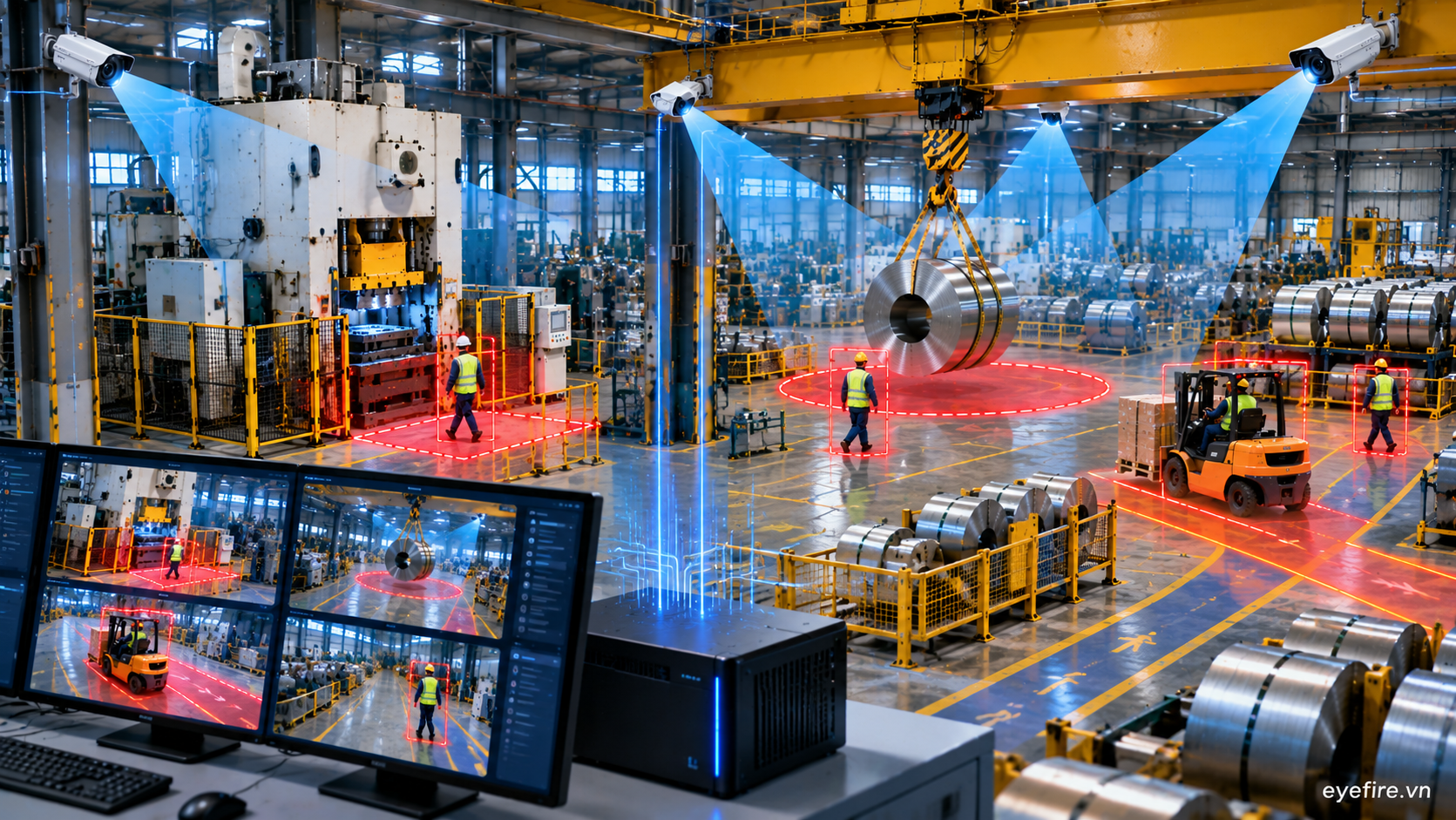
The comparison above describes common differences in AI Camera monitoring system design. In practice, a factory may have both fixed and dynamic hazard zones within the same production line or operating area.
Real-World Application: Monitoring Overhead Crane Hazard Zones with AI Cameras
In steel coil processing factories, overhead cranes are frequently used to lift and transport heavy steel coils. During operations, the load changes position as the crane moves, creating monitoring requirements that differ from those of stationary machinery.
One challenge is continuously observing the area beneath and around suspended loads. Crane operators may have limited visibility, particularly when large loads or factory equipment obstruct parts of the working area.
In an overhead crane safety monitoring application deployed by EYEFIRE at a steel coil processing factory, the system uses four cameras positioned in different directions and moving together with the overhead crane.
The cameras capture images of the monitored area and transmit video data to an AI Hub for analysis. The system helps detect people appearing in hazardous zones according to configured conditions and generates alerts to help on-site personnel recognize potential risks.
A notable aspect of this approach is that the camera arrangement is designed around the movement characteristics of the overhead crane rather than relying solely on a fixed viewing angle within the factory.
However, the actual detection coverage must be determined according to the deployment configuration. It should not be assumed that the system can recognize every hazardous situation, accurately predict load trajectories, or automatically stop the crane unless these functions have been specifically verified.
This example demonstrates that AI Camera deployment should begin with an understanding of how equipment operates, followed by the selection of appropriate camera arrangements and image processing methods.
Key Factors to Consider When Deploying AI Cameras for Hazard Zone Monitoring
Whether monitoring fixed or dynamic hazard zones, businesses need to evaluate actual site conditions before deploying the system.
-
Risk characteristics: Identify hazard sources, accessible locations, operating states, and situations that need to be detected.
-
Camera positioning and viewing angles: Ensure visibility of monitored areas, minimize occlusion, and assess image quality under different conditions.
-
Detection logic: Clarify whether the system needs to detect people entering a monitored zone, people remaining within an area, or situations involving moving equipment.
-
Alert response time: Evaluate processing latency, information transmission, and warning device activation under actual operating conditions.
-
Response coordination: Determine who receives alerts, how personnel should respond on-site, and how response outcomes are recorded.
For dynamic hazard zones, testing should include different equipment positions, movement directions, load sizes, and situations that may cause occlusion.
Businesses also need to evaluate detection rates, missed detections, false alerts, and system stability during continuous operation.
More importantly, AI Cameras do not replace mandatory machinery safety measures, such as protective guards, interlocks, dedicated protective devices, or hazardous energy control procedures. The selection and implementation of these measures must be based on risk assessments and applicable standards.
How Does EYEFIRE Support Hazard Zone Monitoring in Factories?
EYEFIRE develops AI Camera and AI Vision solutions to help businesses detect abnormal situations early in industrial environments.
For hazardous areas with relatively stable boundaries, AI Camera systems can be configured to monitor the presence of people within designated zones, depending on actual requirements and the detection capabilities of the solution.
For applications involving movement, such as overhead cranes, the deployment approach needs to consider camera positioning, the areas requiring observation, and how video data is transmitted to the AI analysis system.
By combining cameras with an AI Hub, EYEFIRE aims to add event detection and alerting capabilities to safety monitoring activities, particularly in areas where continuous manual observation is challenging.
Deployment effectiveness depends on factory conditions, system configuration, and actual testing results. Therefore, conducting on-site assessments and accurately defining monitoring requirements are important steps before selecting a solution.
Conclusion
Both fixed and dynamic hazard zones can be monitored using AI Cameras, but their deployment approaches are not entirely the same.
For fixed hazard zones, businesses can often identify the area that needs to be controlled in advance and establish appropriate detection conditions. Meanwhile, dynamic hazard zones require a more flexible approach to accommodate changes in the positions of equipment, suspended loads, or vehicles during operations.
These differences affect camera placement, monitoring zone configuration, image processing, and alert management.
AI-powered safety monitoring is not simply about detecting people in images. It is about identifying the right area to monitor, under the right operating conditions, and at the right time.