





In modern industrial environments such as manufacturing plants, logistics warehouses, and construction sites, surveillance systems have long played an important role in ensuring safety and operational control. However, most traditional systems still operate at the level of passive recording and monitoring, relying heavily on humans to detect and handle incidents.
The emergence of artificial intelligence (AI), especially in image analysis and AI camera technology, is changing the way we perceive surveillance. Systems no longer simply “observe” — they are beginning to “understand” what is happening in real-world environments, enabling them to issue alerts and respond in real time.
This marks an important shift: from passive monitoring to proactive and intelligent surveillance.
When Cameras Become More Than Recording Devices - Intelligent Sensors
In the past, security cameras primarily served the purpose of recording footage for later review after incidents occurred. Humans remained at the center of the monitoring process, from watching screens to analyzing situations and making decisions.
However, with the advancement of AI, cameras today can do more than just “see” - they can also “understand.”
Modern AI camera systems are capable of recognizing people, vehicles, objects, and behaviors in real time. Instead of merely storing video footage, the system can directly analyze live image streams to detect unusual situations such as unauthorized access to restricted areas, improper movement, violations of safety regulations, or potential accident risks.
Most importantly, this process operates continuously and automatically, significantly reducing dependence on human supervision.
Workplace Safety Elevated to a New Level
In industrial environments, workplace safety is always a critical priority. Even a minor incident can lead to severe human and financial losses.
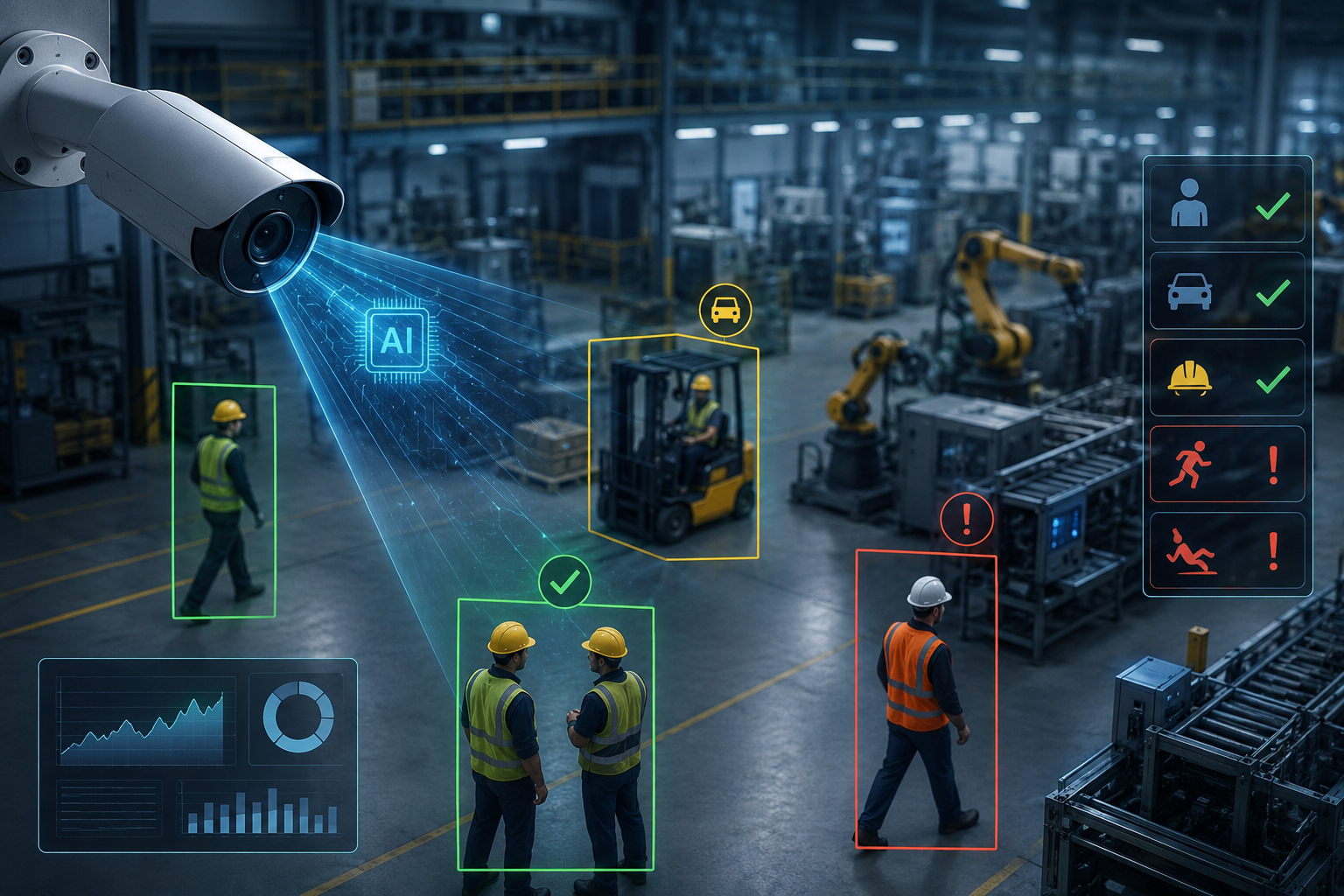
AI cameras introduce a new approach: instead of reacting after incidents occur, the system can identify risks as they begin to emerge.
For example, in a factory or construction site, the system can detect when a worker enters a hazardous area or when safety regulations are violated, such as missing protective equipment. The system can immediately send alerts or activate on-site warning signals to prevent potential accidents.
This transforms the mindset from “incident response” to “incident prevention,” creating a proactive layer of protection across the entire workplace.
Real-Time Production Line and Operational Monitoring
Beyond safety, AI cameras also play an important role in operational monitoring.
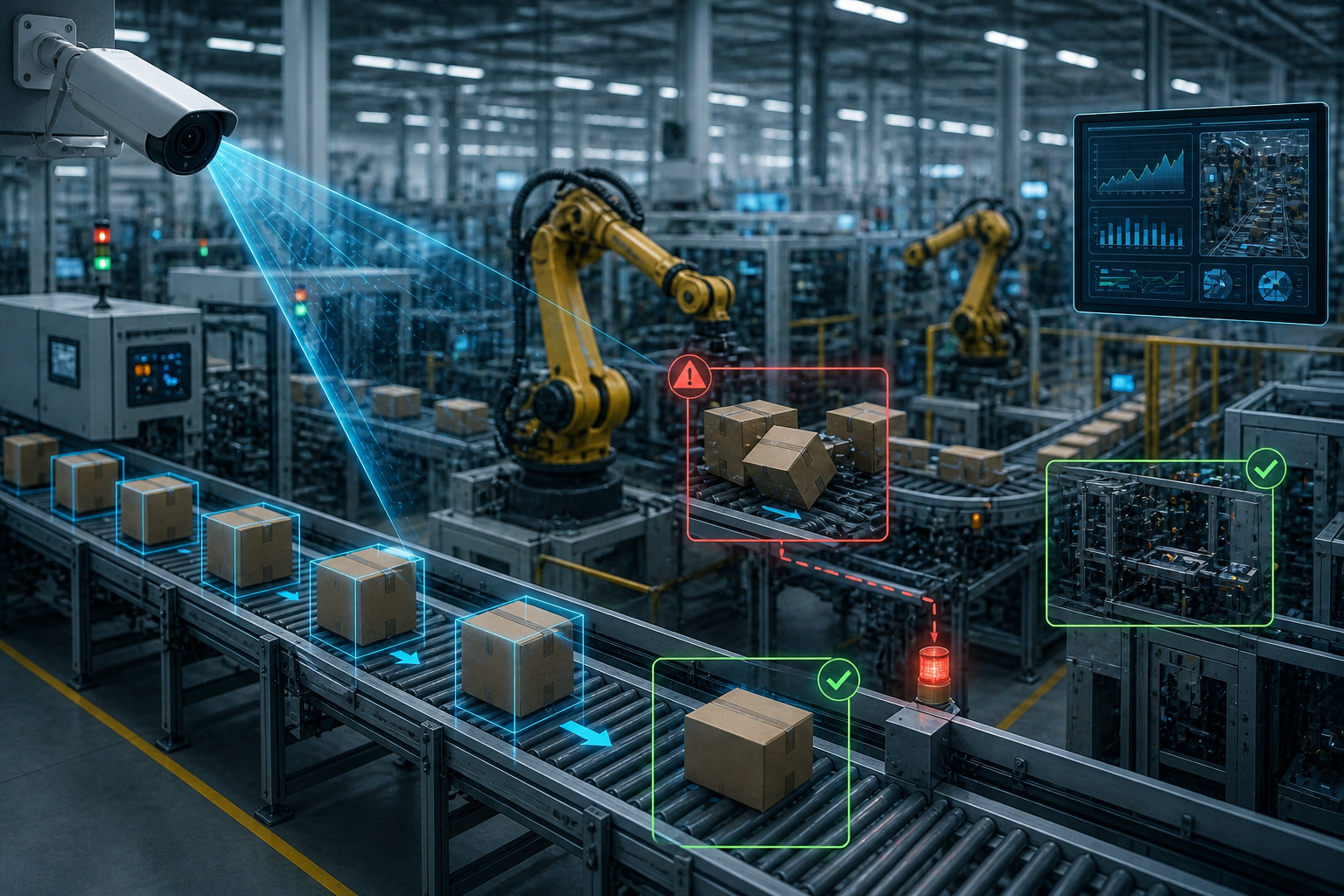
In manufacturing lines or logistics systems, AI can track the movement of goods, detect bottlenecks, identify deviations, or recognize abnormal points within workflows. When issues occur, the system can immediately issue alerts so operational teams can intervene in time.
This helps reduce downtime, optimize operational efficiency, and ensure smoother workflows.
More importantly, this entire monitoring process no longer relies completely on humans, but is supported by real-time image data analysis systems.
From Visual Data to Operational Intelligence
The biggest transformation AI brings is not only the ability to detect events, but also the capability to convert visual data into meaningful information.
Each frame is no longer just static data - it becomes a source of information that helps the system understand:
-
Who is where
-
What is happening
-
Whether risks are emerging
-
The severity of the situation
As a result, the system can generate context-aware alerts instead of generic warnings.
This serves as a crucial foundation for future intelligent surveillance systems, where data is not only collected but also “understood” and “acted upon.”
The Role of AI Cameras in the Modern Industrial Ecosystem
In the era of digital transformation, AI cameras are becoming an essential part of enterprise operational management ecosystems.
Rather than functioning independently, these systems can integrate with other management platforms to create a comprehensive overview of activities within factories or construction sites.
This enables managers to gain more intuitive visibility, make faster decisions, and control risks more effectively.
More importantly, surveillance systems are no longer merely “post-incident inspection tools,” but are gradually becoming part of daily operations.
The Future: Proactive and Adaptive Surveillance Systems
In the future, industrial surveillance systems will evolve beyond event detection toward the ability to adapt autonomously to operational environments.
By combining AI, real-time data, and sensor systems, entire production spaces can become “context-aware,” meaning systems will not only react but also proactively adjust according to situations.
This opens the door to a new model in which factories and construction sites are not only monitored but continuously supported by an intelligent operational layer.
The advancement of AI in image surveillance is creating a major transformation in the way we manage safety and operations in industrial environments.
From simple video-recording camera systems, we are moving toward platforms capable of analyzing, understanding, and responding in real time.
This is not merely a technological upgrade - it is a shift in mindset: from passive monitoring to intelligent surveillance, from reaction to proactivity, and from visual data to operational intelligence.