





For many years, cameras in manufacturing plants and warehouses were primarily viewed as security systems. Businesses installed cameras to record activities on production lines, in storage areas, loading docks, and facility entrances, with the primary purpose of reviewing footage after an incident occurred. Although the number of cameras has continued to grow, most video data is still only reviewed after a problem has already happened.
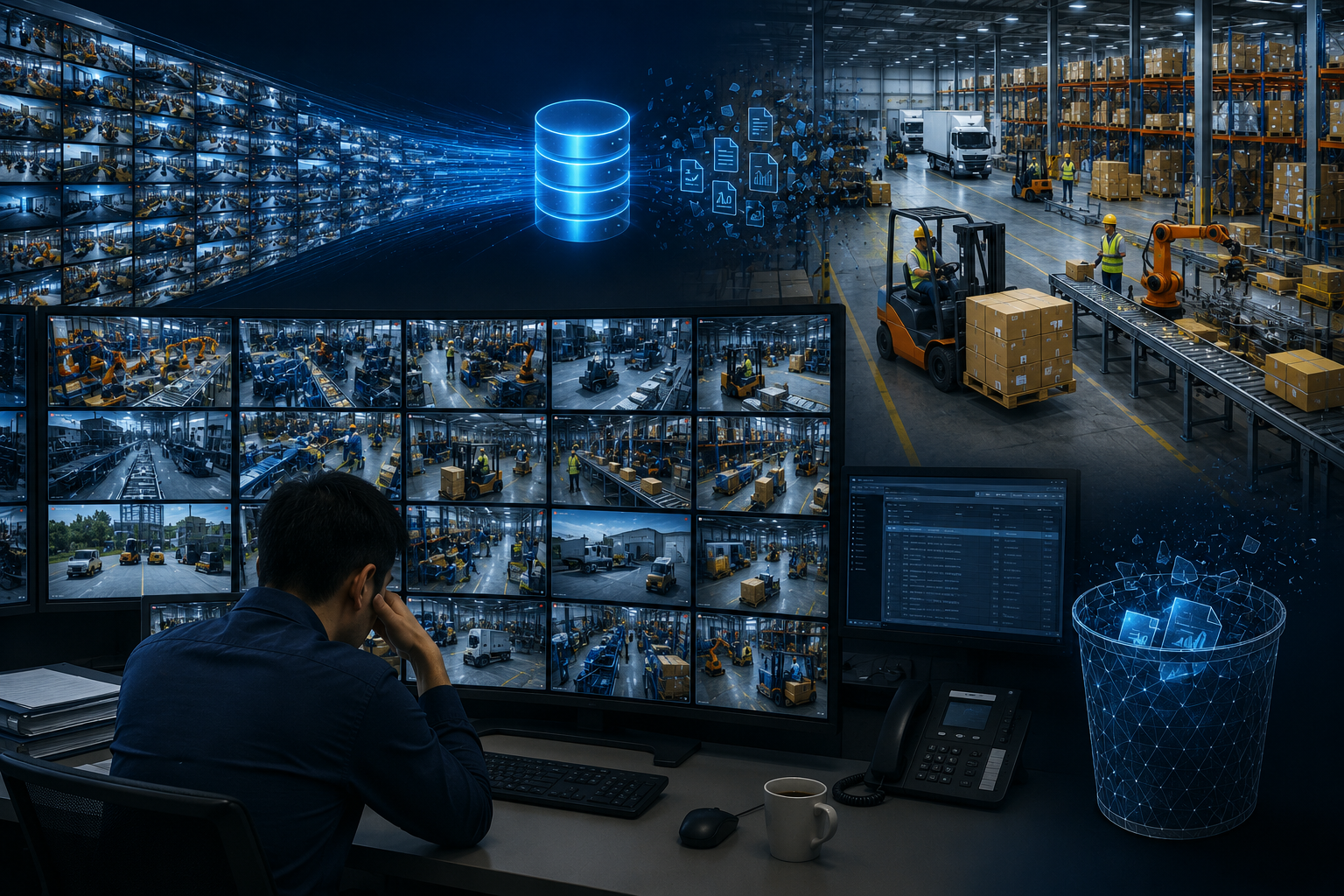
This creates a common paradox. Manufacturing facilities generate thousands of hours of video every day, yet only a small fraction of that data is actually used to improve operations. Cameras have become repositories of evidence rather than tools that help managers identify risks, optimize processes, and improve operational performance.
Artificial intelligence is fundamentally changing that role. Instead of simply recording what has happened, cameras can now analyze what is happening in real time, detect anomalies as they occur, and transform video into valuable operational data. Cameras are no longer limited to helping businesses observe their facilities-they are beginning to help businesses understand how their operations are actually running.
Video Is the Largest-and Most Underutilized-Source of Operational Data
Nearly every activity inside a manufacturing facility takes place in front of a camera. Forklifts move between work areas, employees perform tasks on production lines, products flow in and out of warehouses, machines operate continuously, and vehicles enter and leave the facility-all of these activities are captured on video.
However, video data is fundamentally different from data generated by ERP or MES systems. It is extremely difficult for people to extract meaningful insights from hundreds of hours of recorded footage every day. No one can continuously monitor dozens of camera feeds for hours at a time, nor can they spend hours reviewing recordings just to identify when a pallet was placed in the wrong location or when a forklift entered a restricted area.
This is why a tremendous amount of operational information already exists within camera systems but remains largely untapped. Video contains an enormous amount of valuable information, but without AI-powered analysis, it remains passive footage rather than actionable intelligence.
AI Transforms Cameras from Recording Devices into Intelligent Analytics Systems
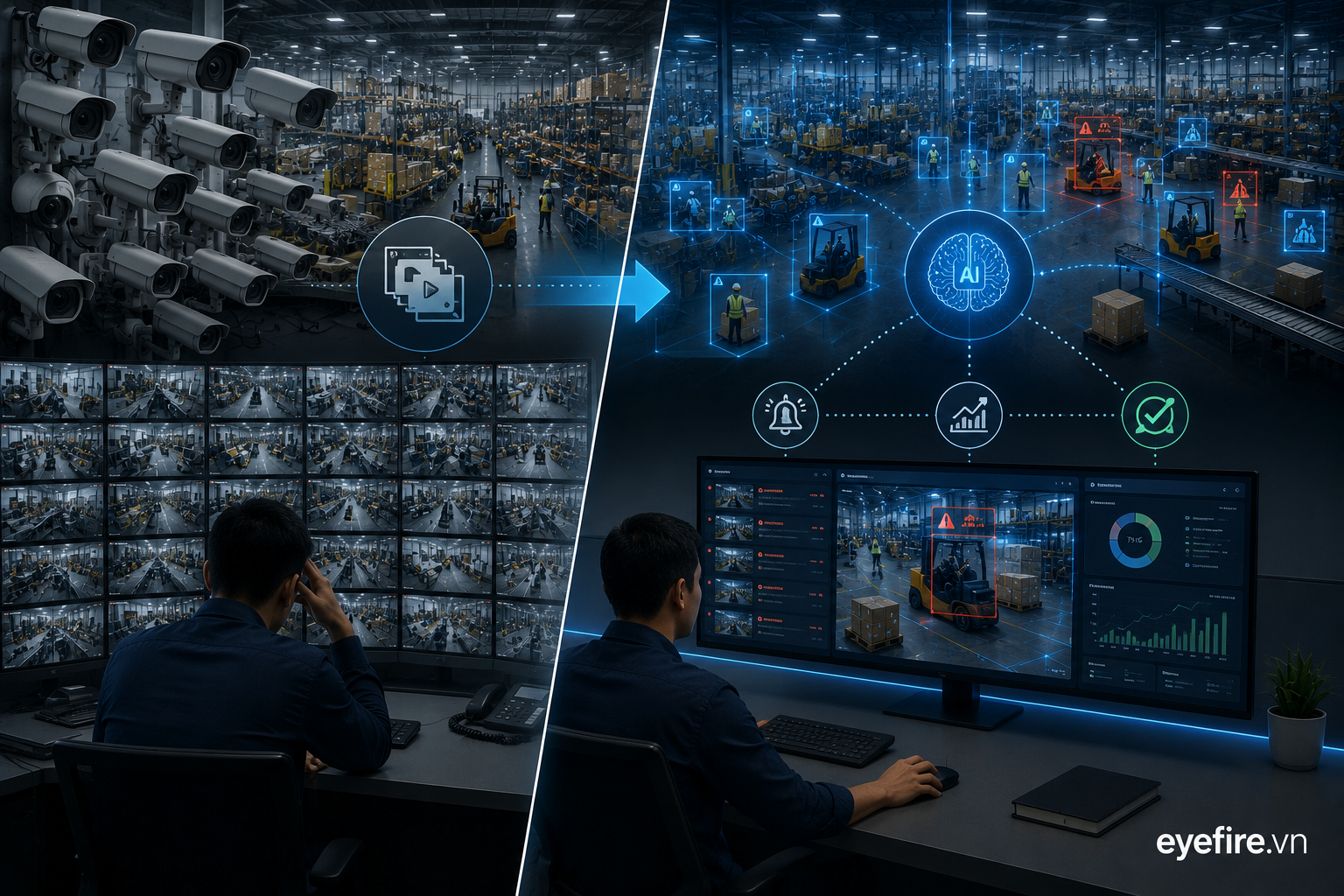
The greatest advantage of AI-powered cameras is not higher image quality-it is their ability to understand what is happening within every frame. Using Computer Vision models, the system can automatically recognize people, vehicles, equipment, objects, and unusual behaviors without requiring continuous human monitoring.
More importantly, AI does more than detect events. It transforms visual information into structured data. Instead of simply knowing that a safety violation occurred, businesses can determine where it happened, when it happened, how frequently it occurs, and whether the trend changes across shifts, departments, or months. These are insights that traditional surveillance systems are simply not designed to provide.
Once video is analyzed in real time, cameras begin to evolve from recording devices into operational intelligence platforms.
Businesses Don't Need More Cameras-They Need Smarter Cameras
Many manufacturing facilities have already invested in hundreds of surveillance cameras over the past decade. The challenge today is not adding more cameras, but making better use of the data that existing cameras already capture.
A security operator cannot effectively monitor dozens of screens simultaneously. Warehouse managers cannot continuously watch every loading area or storage zone. Even dedicated surveillance centers rely heavily on human attention, making it easy to overlook critical events that last only a few seconds.
Artificial intelligence fundamentally changes this approach. Instead of requiring people to search through thousands of hours of video, AI continuously monitors the entire facility and only generates alerts when important events occur. Managers no longer need to watch everything-they simply focus on responding to operational exceptions that truly matter.
The Real Value of AI Cameras Lies in Data, Not Alerts
Many people assume that AI cameras exist simply to generate alerts whenever a violation occurs. In reality, alerts are only the beginning. The greater value comes from collecting, organizing, and analyzing every detected event to provide businesses with a deeper understanding of how their operations perform.
For example, instead of merely identifying that a worker was not wearing a safety helmet, businesses can determine which areas experience the highest number of PPE violations, which work shifts have the greatest compliance challenges, and whether safety training programs are actually improving employee behavior over time. Likewise, instead of simply detecting a forklift traveling in the wrong lane, companies can identify intersections with the highest collision risks and redesign traffic flow or facility layouts accordingly.
As operational data accumulates over time, AI cameras become much more than incident detection tools. They provide continuous insights that help organizations improve processes based on objective operational evidence.
One AI Camera Platform Can Solve Multiple Operational Challenges
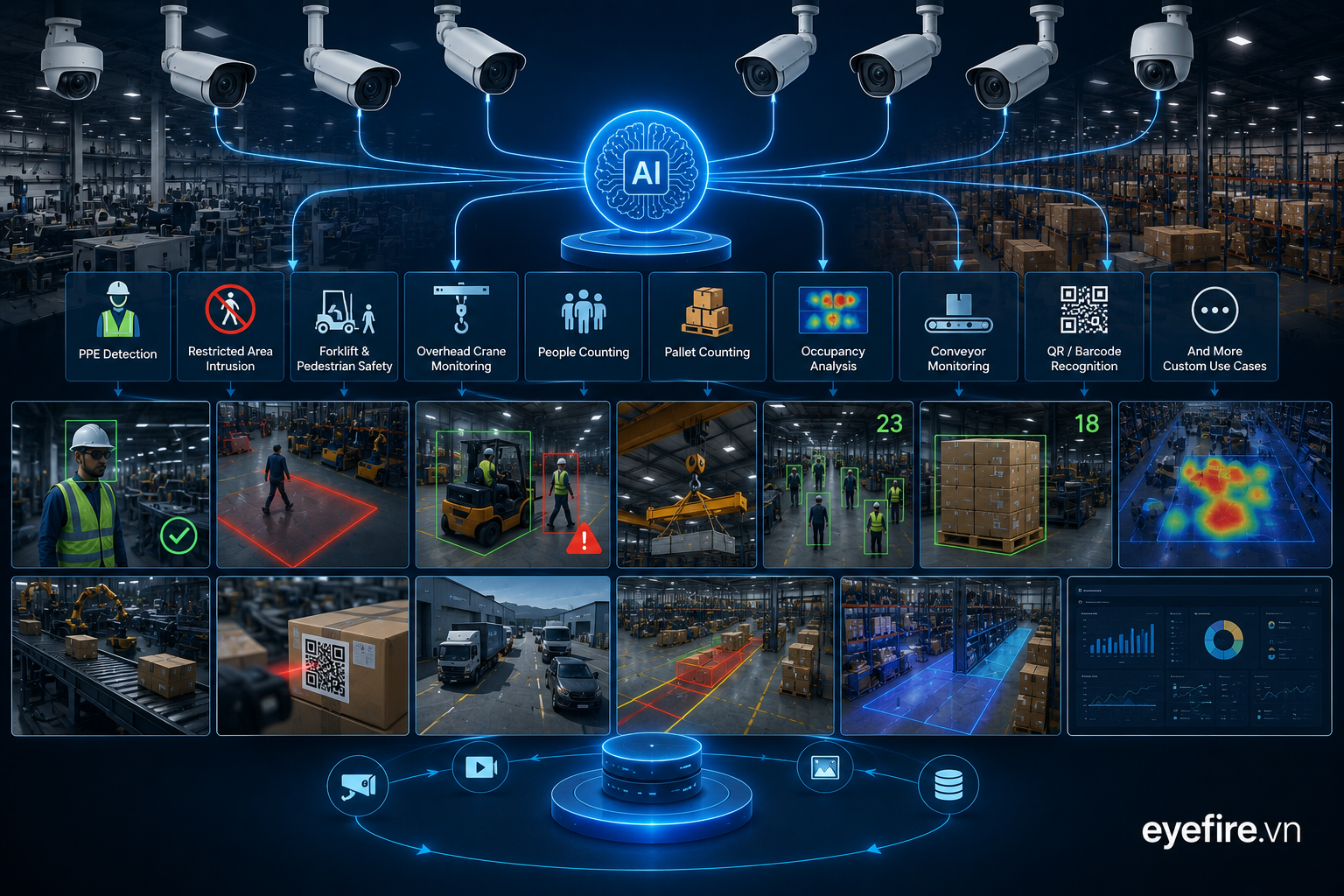
Because AI continuously analyzes video in real time, a single AI camera platform can support a wide range of manufacturing and warehouse applications. Businesses do not need to deploy separate systems for every operational challenge-they can expand capabilities using the same camera infrastructure already installed throughout their facilities.
At EYEFIRE, AI camera technology is being applied across numerous real-world scenarios, including PPE compliance monitoring, restricted-area intrusion detection, forklift collision prevention, overhead crane safety monitoring, people counting, pallet counting, warehouse space utilization analysis, conveyor monitoring, QR code and barcode recognition, as well as many other customized industrial applications designed to meet each customer's operational requirements.
An important advantage is that all of these applications leverage the same video data. As business needs evolve, organizations can deploy additional AI models without replacing their existing camera infrastructure, allowing the system to grow alongside operational requirements.
AI Cameras Will Become an Integral Part of Enterprise Operations
The industry is moving beyond deploying AI cameras as standalone surveillance systems. Increasingly, camera-generated data is being integrated directly with ERP, MES, WMS, EHS, and other enterprise management platforms to create a connected operational ecosystem.
A forklift safety alert can automatically notify the safety department. A production-line anomaly can instantly generate a maintenance work order. A newly received pallet can be synchronized with the warehouse management system in real time. Cameras are no longer simply observing operations-they are becoming a real-time source of data that supports operational decision-making across the enterprise.
Conclusion
As manufacturers continue their digital transformation journey, many organizations focus on digitizing information from ERP, MES, and production management systems. However, one of the largest sources of operational data has existed for years within their camera networks-yet much of it remains largely unused.
When combined with artificial intelligence, cameras evolve far beyond their traditional role as security devices. They become real-time operational intelligence platforms capable of transforming video into actionable business insights. This is the vision EYEFIRE is committed to delivering-helping manufacturers convert video data into meaningful operational intelligence that enhances workplace safety, improves efficiency, and enables the development of smarter, data-driven manufacturing facilities and warehouses.