





Workplace accidents not only harm workers’ health but also lead to compensation costs, production downtime, equipment damage, and resources spent on incident investigations. However, when evaluating an AI Camera system, businesses cannot rely solely on the general claim that it is “safer”; they need to determine the measurable financial value it can deliver.
ROI helps businesses compare the total benefits generated with the full cost of implementation over a defined period. The result provides a basis for deciding whether to run a pilot, expand the system to additional areas, or adjust its configuration.
What Is the ROI of an AI Camera Safety System?
ROI, or return on investment, represents the financial benefit a business receives relative to the amount it has invested.
The basic formula is: ROI (%) = (Total benefits – Total costs) / Total costs × 100%
If a business invests VND 600 million and generates VND 840 million in benefits during the first year, ROI is calculated as follows: ROI = (840 – 600) / 600 × 100% = 40%
This means that, in addition to recovering the initial investment, the business generates additional value equal to 40% of the amount invested.
Businesses should also track the payback period:
Payback period = Total investment cost / Average monthly benefit
The two metrics should be used together. ROI indicates overall effectiveness, while the payback period helps determine when the investment begins to generate net value.
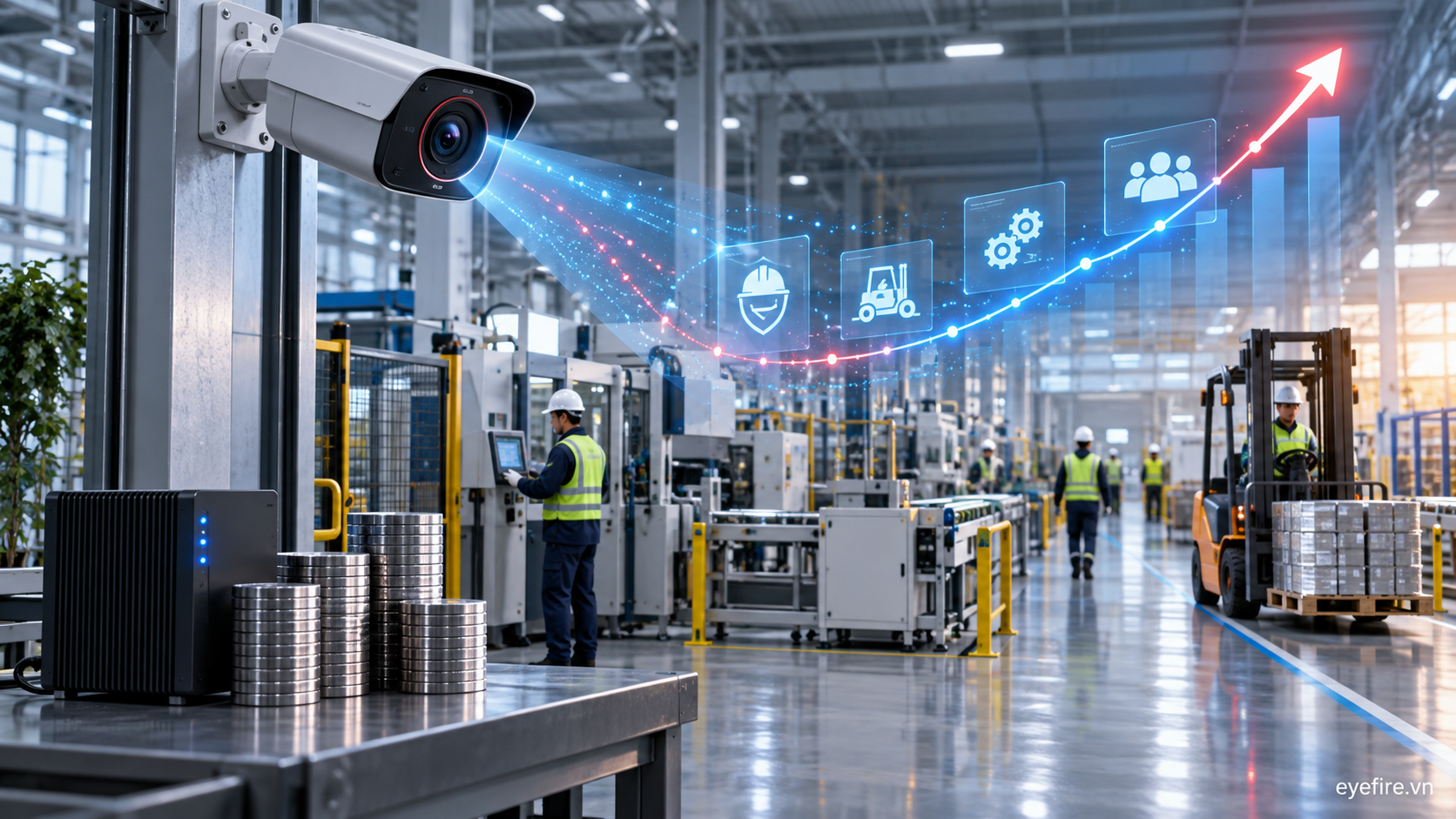
Step 1: Identify the Full Cost of Implementation
A common error when calculating ROI is to include only the cost of purchasing cameras or AI software. In practice, the total cost of ownership needs to cover both the initial investment and the cost of maintaining the system.
Initial investment costs
Depending on the existing infrastructure and the scope of implementation, these costs may include:
-
AI Cameras or new IP cameras;
-
An AI Processing Hub and Edge AI devices;
-
Servers, storage devices, and network infrastructure;
-
Warning lights, sirens, monitors, or display boards;
-
Installation and monitoring-zone configuration costs;
-
AI model training or fine-tuning;
-
Integration with CCTV, VMS, management software, or control systems;
-
Operator training.
If existing cameras meet the requirements for image quality, viewing angle, and connectivity, businesses may be able to reuse part of their infrastructure. However, an on-site assessment is necessary rather than assuming that every existing camera is suitable for an AI application.
Annual operating costs
Once the system is in use, it may incur software licensing fees, equipment maintenance costs, data storage expenses, technical support fees, and AI model update costs. Businesses also need to account for the staff time required to receive, verify, and process alerts.
The general formula can be expressed as follows:
Total costs = Initial investment costs + Operating costs + Additional internal costs
Including all costs from the outset helps prevent an estimated ROI from appearing high while failing to reflect the true total cost of ownership.
Step 2: Determine Current Safety-Related Costs
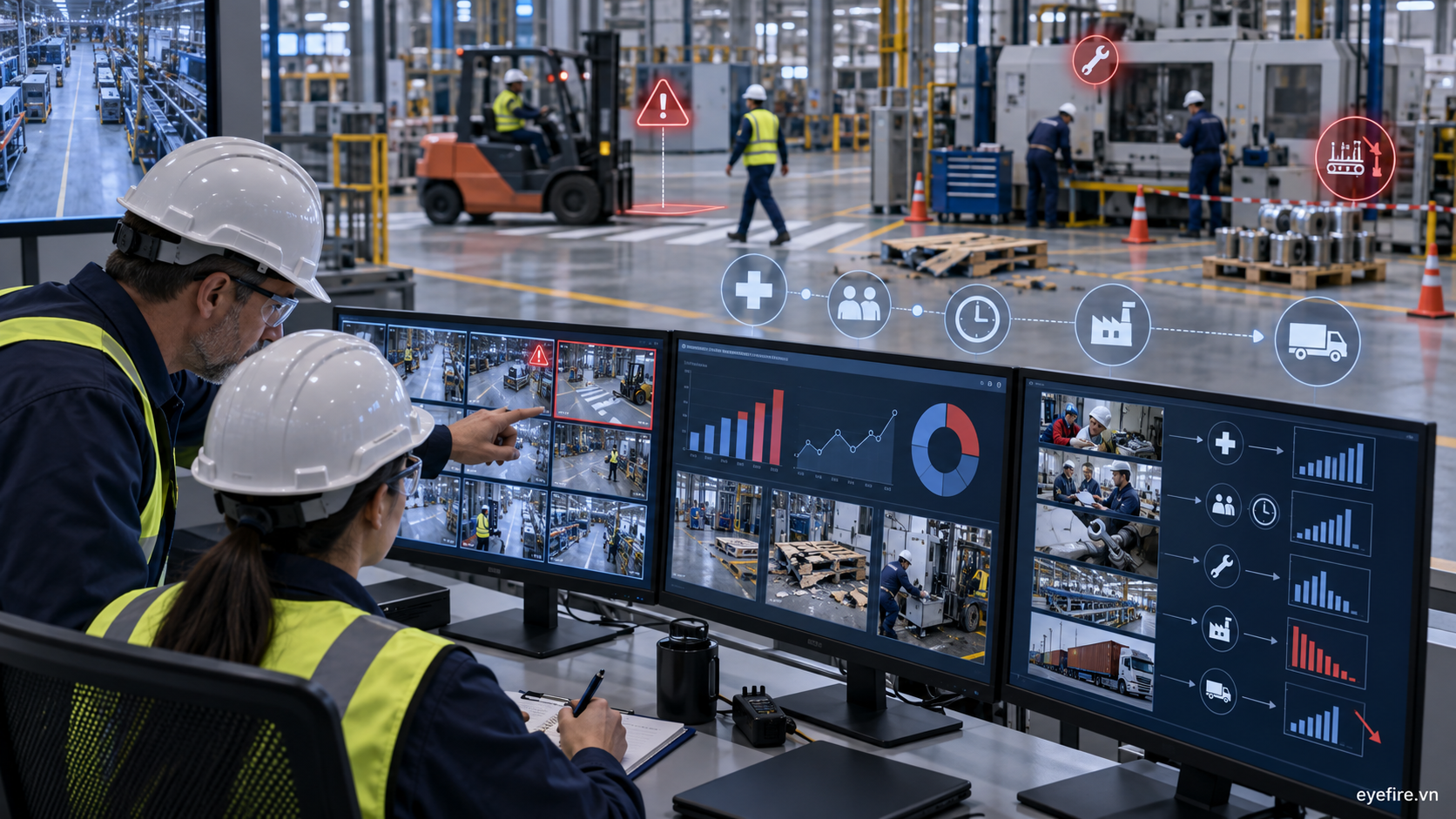
To understand how much value an AI Camera system can generate, a business needs to establish a baseline before implementation. Data should be collected over a period of 6–12 months and should focus on the specific areas where the system will be installed.
The data to be collected includes the number of accidents, near-miss incidents, PPE violations, hazardous-zone intrusions, forklift speeding events, and the average response time. Businesses should also record equipment downtime, the time spent investigating incidents, equipment damage, and the resources currently used for manual monitoring.
The cost of an incident is not limited to expenses supported by invoices. OSHA’s Safety Pays tool distinguishes between direct and indirect costs when assessing the impact of workplace accidents on a business.
Direct costs
Direct costs may include first aid, medical treatment, compensation, machinery repairs, replacement of damaged goods, and site response expenses.
Indirect costs
These costs are more easily overlooked and may include:
-
Production line downtime;
-
Output lost while an incident is being handled;
-
Time spent by managers and the EHS team;
-
Incident investigation, documentation, and camera footage retrieval;
-
Training or arranging replacement personnel;
-
Delivery delays;
-
Effects on reputation and relationships with business partners.
The HSE also notes that effective safety practices can help businesses reduce costs, risks, employee absence, accidents, and the threat of legal action while supporting productivity.
Step 3: Convert the Benefits of AI Cameras into Financial Value
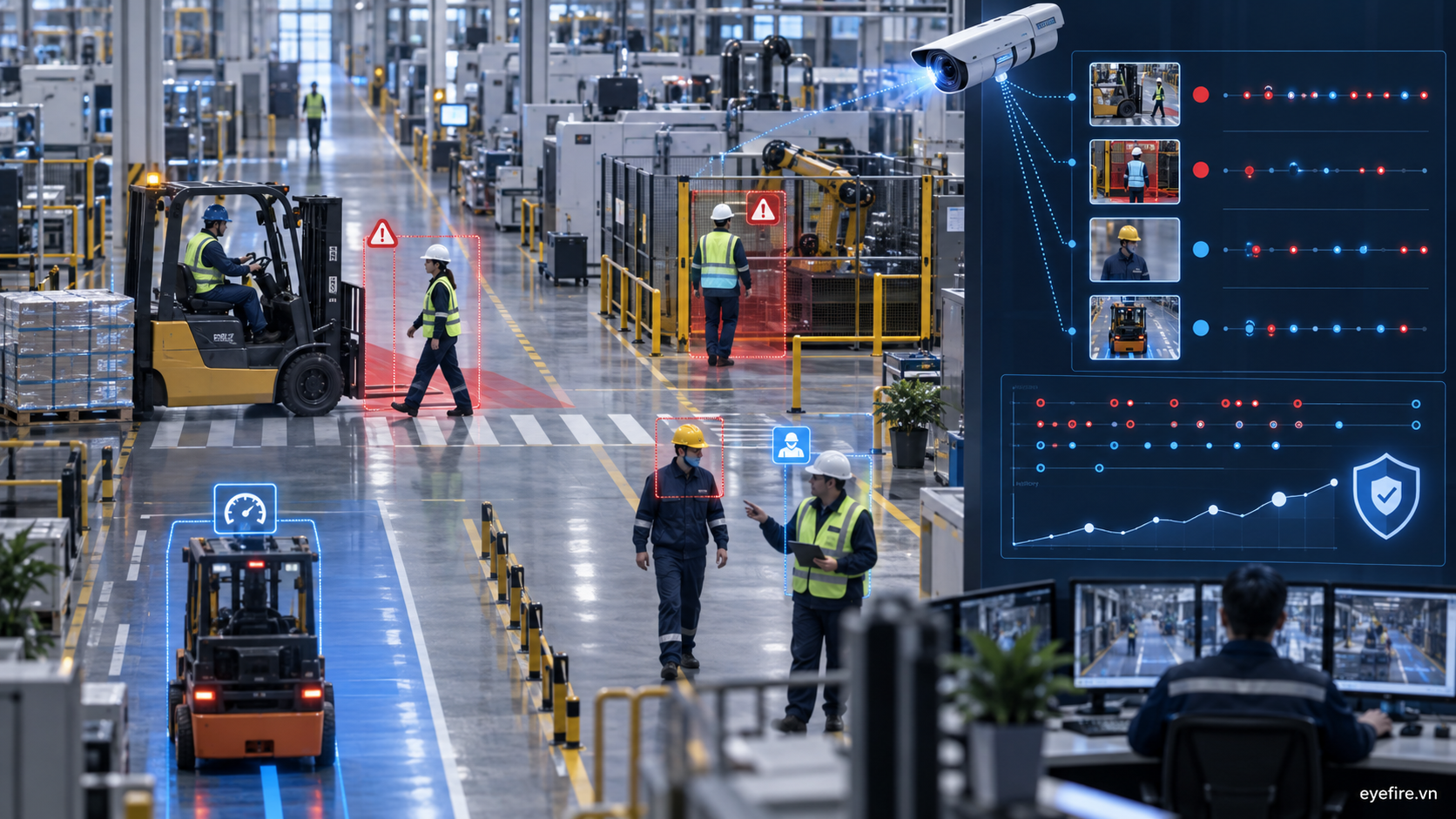
AI safety cameras can detect people entering hazardous zones, PPE violations, speeding vehicles, and collision risks. For example, EyeFire’s system can monitor vehicle speed, save images, and send real-time alerts. It can also establish monitoring zones around robots to detect people approaching while the equipment is operating.
Financial benefits can be divided into four groups.
Avoided incident costs
This value is calculated by multiplying the reduction in accidents or incidents after implementation by the average cost of each type of incident.
Avoided costs = Reduction in the number of incidents × Average cost per incident
Businesses should not take the entire historical cost of accidents and assume that an AI Camera system will eliminate it completely. Comparisons need to cover the same area, the same type of risk, and equivalent periods.
Reduced production downtime costs
If early warnings help prevent collisions, restricted-area intrusions, or obstructions in aisles, businesses may be able to reduce the number of hours of disruption.
Value of reduced downtime = Reduction in downtime hours × Production downtime cost per hour
The hourly cost should be calculated based on lost output, idle labor, restart costs, and effects on delivery schedules.
Time saved on monitoring and investigation
Traditional cameras generally provide only video footage for people to review. AI Cameras can automatically detect, classify, and store events, helping EHS teams spend less time watching screens or searching for relevant footage.
Value of time saved = Number of hours saved × Personnel cost per hour
Only the time that is genuinely freed up and redirected to other activities should be counted. The entire salary of safety personnel should not be treated as savings.
Reduced equipment and goods damage
Collisions involving forklifts, pedestrians, storage racks, and pallets can damage vehicles, goods, or facilities. When AI Cameras help detect blind spots and provide real-time risk alerts, businesses can compare repair costs before and after implementation.
Example of How to Calculate ROI
Suppose a factory deploys AI Cameras at an intersection shared by forklifts and pedestrians. The figures below are intended solely to illustrate the calculation method and do not constitute a quotation or a performance commitment.
Total first-year costs
| Item | Cost |
| Cameras, AI Hub, and warning devices | VND 300 million |
| Installation, configuration, and integration | VND 140 million |
| Training and internal operations | VND 40 million |
|
First-year licensing, maintenance, and support |
VND 120 million |
| Total costs | VND 600 million |
Benefits recorded over 12 months
| Source of benefit | Value |
| Avoided accident and incident costs | VND 320 million |
| Value of reduced production downtime | VND 210 millio |
| Time saved on monitoring and investigations | VND 180 million |
| Reduced equipment and goods damage | VND 130 million |
| Total benefits | VND 840 million |
Therefore: ROI = (840 – 600) / 600 × 100% = 40%
Payback period = 600 / (840 / 12) = approximately 8.6 months
From the ninth month onward, the system begins to generate net value if the benefits continue to be sustained.
ROI Should Not Be Measured Solely by the Number of Accidents
Serious accidents occur infrequently but can have major consequences. If a business waits only for a reduction in accident numbers, it may take a long time to collect enough data to determine effectiveness.
During the initial stage, businesses should also monitor leading indicators such as:
-
The number of near-miss events detected;
-
The number of hazardous-zone intrusions;
-
The frequency of PPE violations;
-
The number of vehicle speeding events;
-
The time from detection to resolution;
-
The rates of valid and false alerts;
-
The rate of repeated violations in the same area;
-
The number of hours saved on monitoring or video retrieval.
These indicators show whether the system helps detect risks early and change safety behavior. Once sufficient data has been accumulated, businesses can convert the results into avoided costs.
How Can ROI Results Be Made More Reliable?
Before implementation, businesses need to agree on the measurement scope, comparison period, and data sources. Before-and-after results must be measured in the same area, during the same shifts, and at comparable production levels.
Businesses should also develop three scenarios: conservative, base, and expected. Each scenario should use different assumptions for reductions in incidents, time savings, and operating costs. This approach allows decision-makers to see the potential range of outcomes rather than relying on a single figure.
Double-counting benefits must also be avoided. If production downtime is already included in the total cost of an accident, it should not be added again as a separate benefit. Benefits that are difficult to convert into financial terms, such as corporate image, safety culture, or employee trust, may be recorded separately but should not be assigned an arbitrary monetary value.
Start with a Scope That Is Small Enough to Measure
Instead of deploying the system across the entire factory at once, a business can begin in an area with a clearly identified risk, such as a forklift intersection, a robot operating zone, an area beneath an overhead crane, or a location where PPE violations occur frequently.
A pilot project should have baseline data, specific objectives, and acceptance criteria from the outset. After a period of operation, the business can evaluate accuracy, alert speed, reductions in violations, and financial benefits before deciding whether to expand the system.
Conclusion
The ROI of an AI Camera safety system does not come only from reducing the number of accidents. Its value also lies in detecting risks early, shortening response times, reducing production disruptions, and providing data to improve safety processes.
To obtain reliable results, businesses need to calculate the full total cost of ownership, establish baseline data, and record only benefits that can be verified. When deployed for the right use case and measured consistently, an AI Camera system is no longer merely a preventive investment; it becomes a tool that supports risk management and optimizes factory operations.