





In modern manufacturing factories, occupational safety depends not only on protective equipment or technical procedures but is also closely tied to very small behaviors during work. One of the most common groups of accidents in industrial environments is accidents caused by slipping or collisions while moving. These incidents often occur within very short moments, but the consequences can last for many months or even cause permanent disability.
According to many occupational safety statistics, slipping and tripping are among the most common causes of injuries in the workplace. In the United States, occupational accident studies show that hundreds of thousands of injury cases each year are related to slips, trips, or falls during work. In 2020, there were more than 211,000 serious injuries due to falls that caused workers to miss work for several days, and more than 800 fatalities due to fall-related workplace accidents. These numbers show that seemingly small risks during movement can actually become serious issues for businesses.
In the safety culture of Japanese companies, a well-known method used to reduce these risks is a behavioral rule set called Poketenashi. This is a way to remember five safe walking principles in factories. These principles help workers maintain focus and form safe movement habits in the production environment.
The first principle of Poketenashi is Po, short for “Pocket.” This principle requires workers not to put their hands in their pockets when walking in the factory. At first glance, this may seem like a very small rule, but upon deeper analysis, it is directly related to reaction ability and worker safety in the production environment.
Why putting hands in pockets while walking is dangerous
In factories, the working floor is rarely in an ideal condition like in an office. The floor surface may contain many slippery factors such as oil, water, metal dust, or small material fragments. In some areas, electrical wires, pallets, or moving equipment can also become unexpected obstacles.
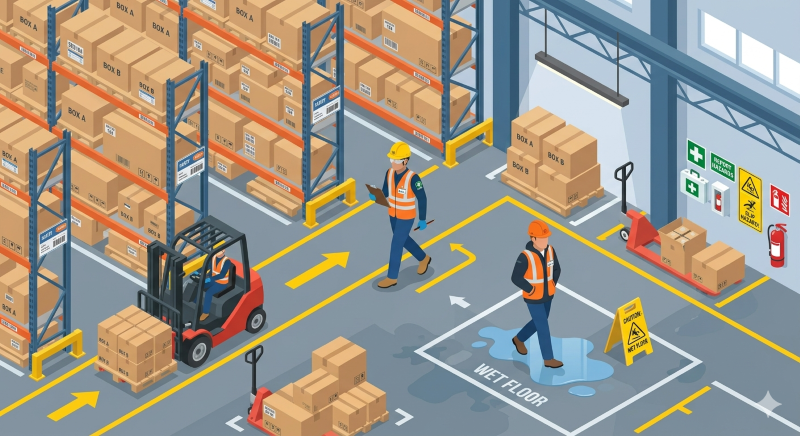
Occupational safety studies indicate that most slip and fall accidents occur in seemingly normal situations such as walking through corridors, stepping down stairs, or turning along walkways. These incidents often happen in an instant. When the body begins to lose balance, the natural human reflex is to extend the hands forward or to the side to maintain balance and reduce impact force.
If both hands are in the pockets, this reflex is delayed or cannot be performed in time. Even a fraction of a second of delay can prevent the body from adjusting its center of gravity. The consequence may be falling directly onto the floor or colliding with surrounding equipment.
Falls in industrial environments often cause more serious injuries than in office environments. In addition to broken arms or sprains, many cases also result in head or spinal injuries. Occupational safety studies show that about 20 to 30 percent of workplace falls can cause significant injuries such as fractures or concussions.
Another less noticed factor is that putting hands in pockets changes how the body maintains balance while walking. When both arms are freely moving, they swing in rhythm with the steps and help the body maintain stability. This is a natural mechanism that helps humans maintain balance while moving. When the arms are fixed inside the pockets, this balancing movement is restricted, increasing the risk of losing balance.
In factory environments with forklifts, autonomous robots, or material handling equipment, quick reflexes play an especially important role. When a moving device suddenly appears, workers must be able to stop or evade immediately. Free hands help the body be more flexible in such situations.
Safety culture and behavioral discipline in Japanese factories
Japanese companies are well known for building a safety culture based on behavioral discipline. Instead of relying only on protective equipment, they focus on forming correct working habits starting from the smallest actions.
Poketenashi is a typical example of this approach. By associating each principle with an easy-to-remember letter, factories help workers remember safety rules during movement. Not putting hands in pockets while walking becomes a common behavioral standard in the factory.
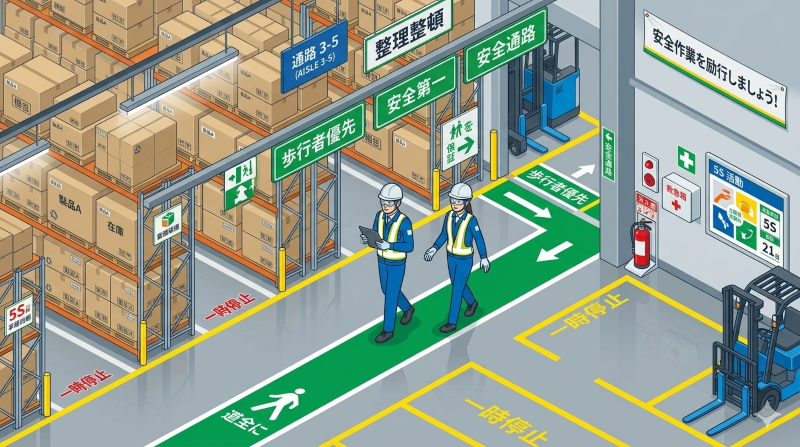
When all employees follow the same behavioral standard, the working environment becomes more consistent and predictable. This is especially important in areas where humans interact with automated machines.
However, in practice, maintaining absolute compliance is still a challenge. After a period of working, people tend to return to personal habits. Fatigue at the end of a shift or complacency in familiar areas may cause workers to unintentionally violate safety rules.
Limitations of manual monitoring
In large factories, hundreds or even thousands of employees may be moving at the same time. Production areas, warehouses, and connecting corridors form a very large spatial system.
Relying entirely on managers or safety staff to observe each person’s behavior is almost impossible. Even when factories have surveillance camera systems, most traditional cameras only record footage without the ability to analyze behavior.
This means that many dangerous behaviors are only detected after incidents have already occurred. Meanwhile, the goal of modern safety management is to detect risks before accidents happen.
AI cameras help detect hand-in-pocket behavior while moving
The development of computer vision technology has provided an effective solution to this problem. AI cameras not only record like traditional systems but also have the ability to analyze images in real time to recognize human behavior in the working environment.
Through human recognition and posture analysis models, the system can determine the position of the arms, direction of movement, and motion state of workers within the frame. When a person is detected moving with both hands fixed close to the body or placed in their pockets, the system can recognize this as a violation of safety rules in the factory.
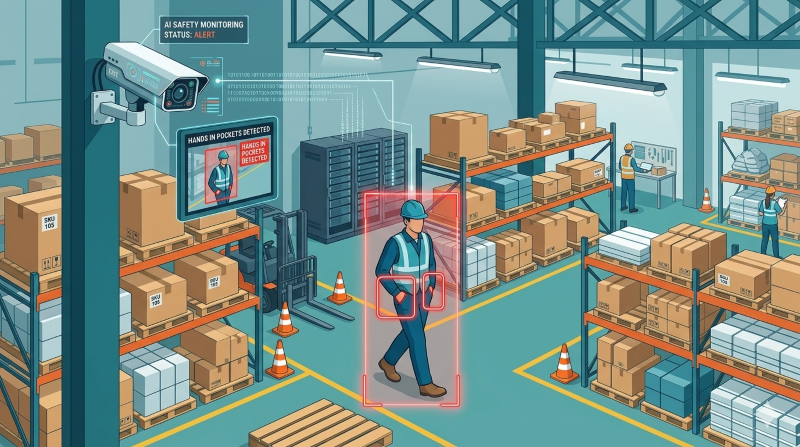
This detection capability is particularly useful in high-risk areas such as shared walkways, corridors between production lines, or intersections with forklifts. When hand-in-pocket behavior is detected, the system can record the event and send alerts to management or display notifications directly in the work area. As a result, workers can adjust their behavior immediately before an incident occurs.
In addition to real-time detection, AI cameras also help businesses collect behavioral data during factory operations. This data allows safety departments to analyze violation trends by area, shift, or time of day. By understanding when and where high-risk situations occur, businesses can proactively adjust operational processes, improve walkway design, or enhance safety training for workers.
EYEFIRE Safety and behavior monitoring solutions in factories
The EYEFIRE Safety AI camera solution is developed to support businesses in monitoring safety behavior in production environments. The system uses Edge AI technology to analyze image data directly on the camera or processing device near the data source.
Thanks to its ability to recognize humans and analyze posture, the system can determine the position of the arms relative to the body when a person is moving. When it detects a worker moving with both hands fixed close to the body and without natural arm movement, the system can identify this as hand-in-pocket behavior.
After detecting dangerous behavior, the system can send alerts to the control center or display notifications in the work area. This helps workers recognize their behavior and adjust immediately.
Another important benefit of the system is its ability to store and analyze behavioral data over time. Instead of only handling individual events, businesses can use the data to better understand risk trends in the factory.
For example, if the system detects that hand-in-pocket behavior occurs more frequently at the end of a shift, this may reflect worker fatigue. From this, businesses can adjust break times or improve working conditions to reduce risks.
Conclusion
The Po principle in Poketenashi shows that very small behaviors during movement can directly affect occupational safety. Not putting hands in pockets while walking helps workers maintain reaction ability, keep better balance, and be ready to handle unexpected situations in the factory.
However, in modern manufacturing environments with large scale and high work pace, monitoring behavior by humans alone is not sufficient. AI camera technology provides an additional layer of protection by monitoring behavior in real time and detecting risks early.
When combined with safety culture and employee training, solutions such as EYEFIRE Safety can help businesses shift from a reactive approach after accidents to a proactive prevention model. This not only helps reduce workplace accidents but also contributes to building a safer and more sustainable manufacturing environment in the long term.