





In an industrial manufacturing environment, areas such as production lines, transport corridors, and warehouses are often designed across multiple levels. This makes staircases an indispensable part of the factory structure. However, these seemingly simple areas actually contain many accident risks if workers do not comply with proper safety rules when moving.
According to many occupational safety reports worldwide, accidents related to staircases account for a significant proportion of total slip-and-fall incidents in the workplace. Just one missed step or a moment of imbalance can lead to serious injuries to the knees, wrists, or spine. In industrial environments, where workers often wear heavy safety shoes or carry tools, this risk becomes even greater.
Therefore, in the safety culture of Japanese companies, the use of handrails when going up and down stairs is considered a basic but extremely important behavior. This principle is called Te in the Poketenashi rules. The term Tesuri in Japanese means stair handrail, and the Te principle emphasizes that workers must always hold the handrail when moving on stairs in the factory.
Although it is just a small action, holding the handrail can make a big difference in preventing workplace accidents.
Why staircases are high-risk areas in factories
In an office environment, staircases are usually used at low density and are less affected by production factors. However, in factories, the situation is completely different.
Workers may have to move between floors multiple times during a shift. During this process, they may carry equipment, components, or documents for work. When body weight shifts or vision is limited by objects in hand, the ability to maintain balance when going up or down stairs is significantly reduced.
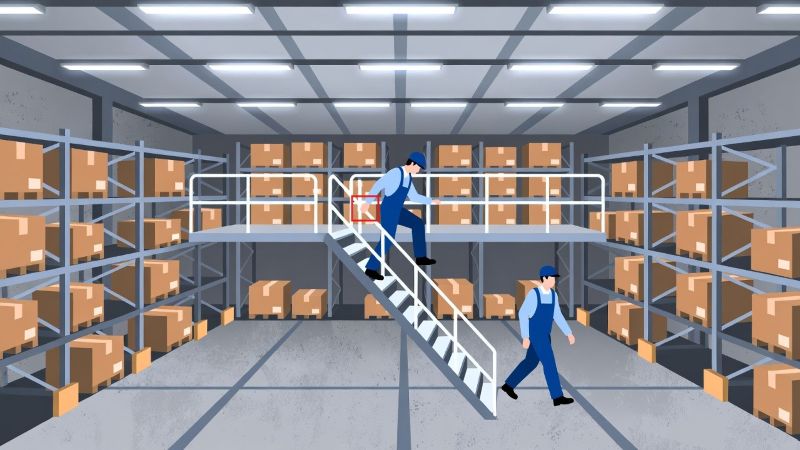
In addition, the surface of staircases in factories can sometimes be affected by industrial dust, grease, or water. These factors increase the risk of slipping. When a person misses a step on the stairs, the impact force is often greater than slipping on a flat surface due to the height difference between steps.
In such situations, the handrail acts as a support point to help workers maintain balance and reduce impact force. With just one hand holding the rail, the body can quickly stabilize when a slip occurs.
Another factor that makes staircases dangerous is the high traffic density at certain times of the day, such as the start of shifts, break times, or the end of shifts. When many people move at the same time in a narrow space, the risk of collision or loss of balance increases.
The Tesuri principle in Japanese Poketenashi
In the Poketenashi system, the Te principle reminds workers to always hold the handrail when going up and down stairs. This is a small behavior but carries important meaning in maintaining safety when moving in factories.
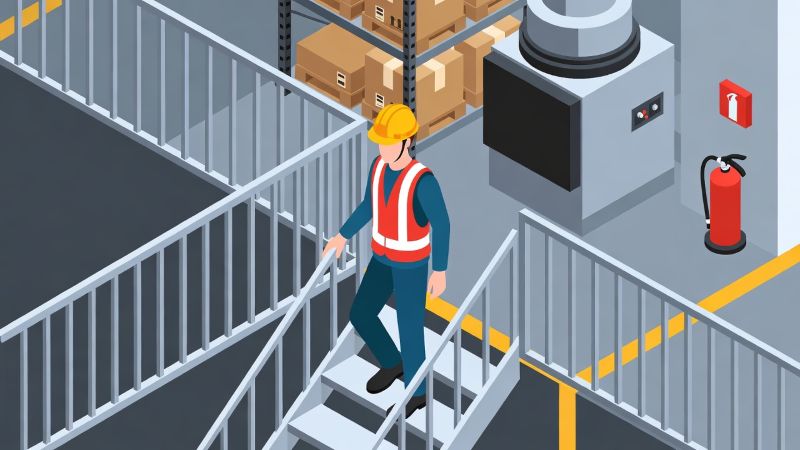
Japanese safety philosophy often focuses on standardizing human behavior rather than relying solely on protective equipment or technology. When everyone in the factory follows the same rules, the working environment becomes more disciplined and predictable.
Holding the handrail also helps workers form a controlled movement habit. Instead of walking quickly by inertia, they tend to pay more attention to each step when going up or down stairs.
In many Japanese factories, this principle is frequently reinforced in safety training programs. Signs at stair areas also often remind workers to use handrails when moving.
However, like many other safety rules, maintaining long-term compliance is not always easy. When workers become familiar with the work environment, they may unintentionally overlook small actions such as holding the handrail, especially when in a hurry or carrying items.
Challenges in monitoring handrail usage behavior
In large factories, staircases can be located in many different places, connecting production areas, warehouses, and offices. Monitoring whether each person holds the handrail when going up and down stairs is a difficult task if relying only on human observation.
Safety staff cannot stand at every staircase throughout the entire factory operating time. Even when surveillance cameras are installed, traditional cameras usually only record footage without the ability to analyze behavior.
This makes violation detection passive and often only happens after an accident has occurred.
In the context of factories increasingly moving toward smart manufacturing models, many businesses are seeking technological solutions that can support automatic monitoring of safety behavior.
AI cameras help detect non-handrail behavior on stairs
Computer vision technology has brought a new advancement in occupational safety monitoring. AI cameras can analyze images in real time and recognize human behavior within the frame.
In staircase areas, the system can be configured to recognize workers going up and down. By analyzing posture and arm position, the system can determine whether the person is holding the handrail.
If a person moves on the stairs without any contact between their hand and the handrail during ascent or descent, the system can record this as behavior that needs to be reminded.
This detection capability is especially useful in high-traffic stair areas. When the system detects dangerous behavior, alerts can be sent to management or displayed directly in the work area to remind workers.
In addition to real-time alerts, AI cameras also help businesses collect behavioral data over time. From this data, safety departments can analyze compliance levels of workers at different staircase areas in the factory.
If a staircase location has a high rate of non-handrail usage, this may indicate a need to improve handrail design, add warning signs, or strengthen safety training.
EYEFIRE Safety and behavior monitoring solutions at stair areas
The EYEFIRE Safety AI camera solution is designed to support businesses in monitoring safety behavior in manufacturing environments. The system uses Edge AI technology to analyze image data directly on the device, enabling real-time detection of dangerous behavior.
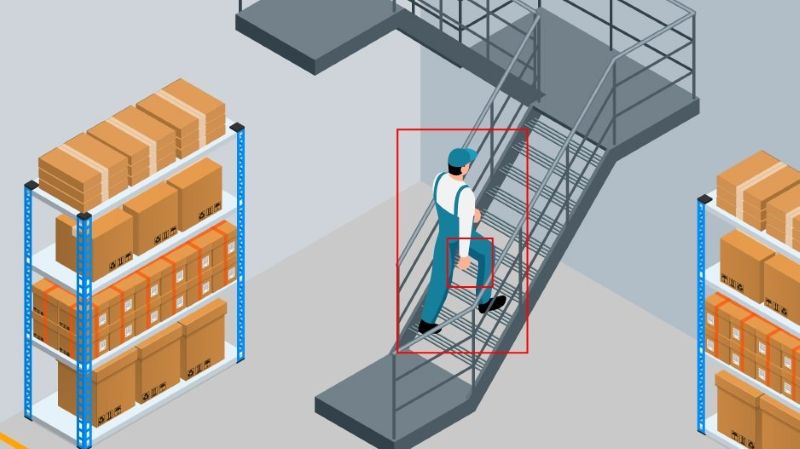
In staircase areas, the system can be configured to track worker movement and analyze the position of the arms relative to the handrail. When detecting stair usage without holding the handrail, the system can record the event and send alerts to the control center.
In addition to alert functions, the system also provides statistical data that helps businesses evaluate behavioral trends in the factory. Through these reports, safety departments can identify high-risk areas and implement appropriate improvement measures.
The combination of Poketenashi safety principles and AI camera technology helps businesses build a proactive safety management system. Instead of only reacting after accidents occur, businesses can detect risky behaviors early and prevent incidents before they happen.
Conclusion
The Te principle in Poketenashi emphasizes that holding the handrail when going up and down stairs is a simple action but can significantly reduce the risk of accidents in factories. When workers maintain this habit, they can keep better balance and react faster in situations of slipping or instability.
However, in modern factories with large scale and high work pace, monitoring safety behavior using humans alone is not sufficient. AI camera technology provides an effective solution by monitoring behavior in real time and detecting risks early.
By combining Japanese safety culture with technological solutions such as EYEFIRE Safety, businesses can build a safer working environment, reduce workplace accidents, and improve operational efficiency in the long term.