


Many factories have already invested in surveillance camera systems across production areas, warehouses, and locations with potential safety risks. However, most traditional CCTV systems primarily serve to monitor and record footage, while detecting hazardous situations still depends on personnel watching camera feeds.
An AI Hub is one solution that adds artificial intelligence-powered video analytics to surveillance systems. By receiving and processing camera footage, an AI Hub can help detect abnormal events, generate alerts, and provide information that enables responsible personnel to respond promptly.
So, what is an AI Hub, how does it work, and what role does it play in upgrading traditional CCTV into an intelligent factory safety monitoring system?
What Is an AI Hub?
An AI Hub is a central processing device or platform capable of receiving video data from one or multiple cameras and using artificial intelligence models to analyze footage and identify events based on specific requirements.
In factory safety monitoring systems, an AI Hub can process video from IP cameras to detect people entering hazardous areas, identify non-compliance with safety regulations, or monitor situations that could potentially lead to accidents.
Unlike traditional cameras that simply capture footage, an AI Hub adds a layer of data analysis powered by Computer Vision. As a result, the system not only provides video for observation but also helps identify events that require attention.
Depending on the deployment architecture, an AI Hub can be a processing device installed at the factory or a component of a video analytics platform. In an on-premises processing model (Edge AI), video data is analyzed within the company's own infrastructure, reducing the need to transmit entire video streams to cloud-based systems.
However, AI Hub does not refer to a single hardware configuration or technical standard. Processing capabilities, the number of supported cameras, and AI functionalities vary depending on the specific solution.
How Does an AI Hub Work in an AI Camera System?
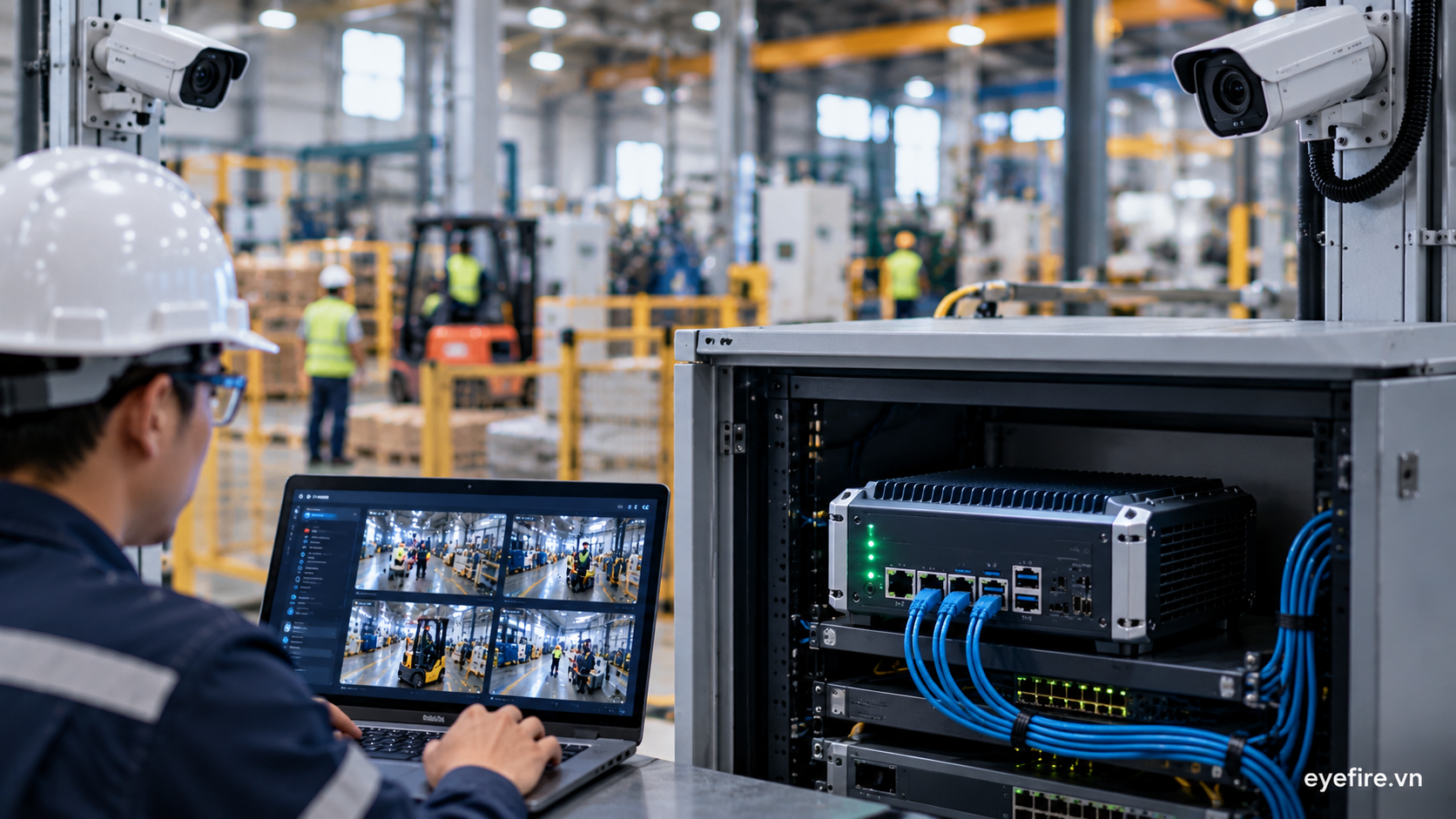
A factory safety monitoring system using an AI Hub typically combines IP cameras, network infrastructure, an AI processing unit, and alert management software.
The operating process can be described through the following stages.
Receiving data from cameras: IP cameras capture footage in designated monitoring areas and transmit video streams to the AI Hub through the network. Depending on the devices, connections may use compatible protocols and standards such as RTSP or ONVIF.
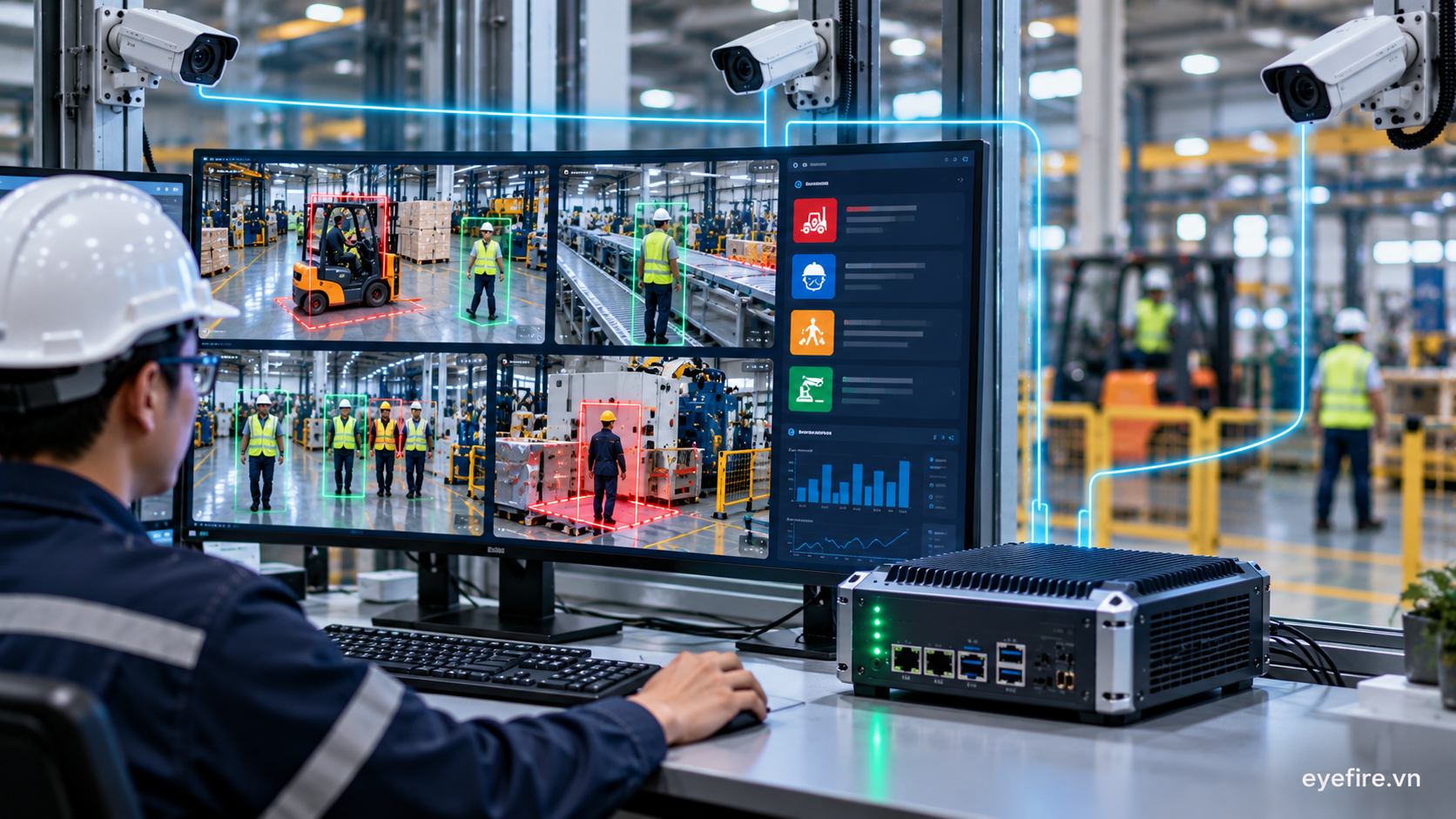
Analyzing footage using AI: The AI Hub uses Computer Vision models to identify people, vehicles, equipment, or movement patterns within video footage. The analysis results are compared against predefined monitoring conditions to identify abnormal events.
Detecting events and generating alerts: When an event meets the configured alert conditions, the system can record its timestamp, associated camera, and event images. Depending on the configuration, notifications can be sent to a management interface, responsible personnel, or on-site warning devices.
Verification and response: Responsible personnel receive the information, review the situation, and take appropriate action. For serious hazards, warning or protective mechanisms must be designed to respond promptly according to safety requirements, without depending entirely on human confirmation of notifications.
Monitoring and continuous improvement: Event data and response results can be aggregated to assess safety conditions, identify areas where risks frequently occur, and adjust existing control measures.
Through this process, the AI Hub connects video data from cameras with safety event detection, alerting, and management activities. However, whether the system fully supports storage, event management, or reporting functions depends on the software and deployment configuration.
The Role of AI Hubs in Factory Safety Monitoring
Adding AI Analytics Capabilities to Existing CCTV Systems
One of the notable applications of an AI Hub is the ability to utilize existing IP camera systems while adding video analytics capabilities.
Instead of replacing all cameras with AI-integrated devices, businesses can consider connecting compatible cameras to an AI Hub to process video and detect events based on their monitoring requirements. This approach can help make use of existing infrastructure and enable deployment in prioritized areas.
However, not every IP camera is suitable for use with an AI Hub. Compatibility depends on factors such as video transmission protocols, resolution, frame rate, image quality, installation angle, and the requirements of the AI model.
Therefore, before upgrading CCTV systems, businesses should assess their existing infrastructure to determine which cameras can continue to be used and which locations require adjustments or additional equipment.
Supporting Early Detection of Unsafe Situations
In manufacturing environments, many risks arise within short periods and may go unnoticed when monitoring relies solely on personnel manually watching camera feeds.
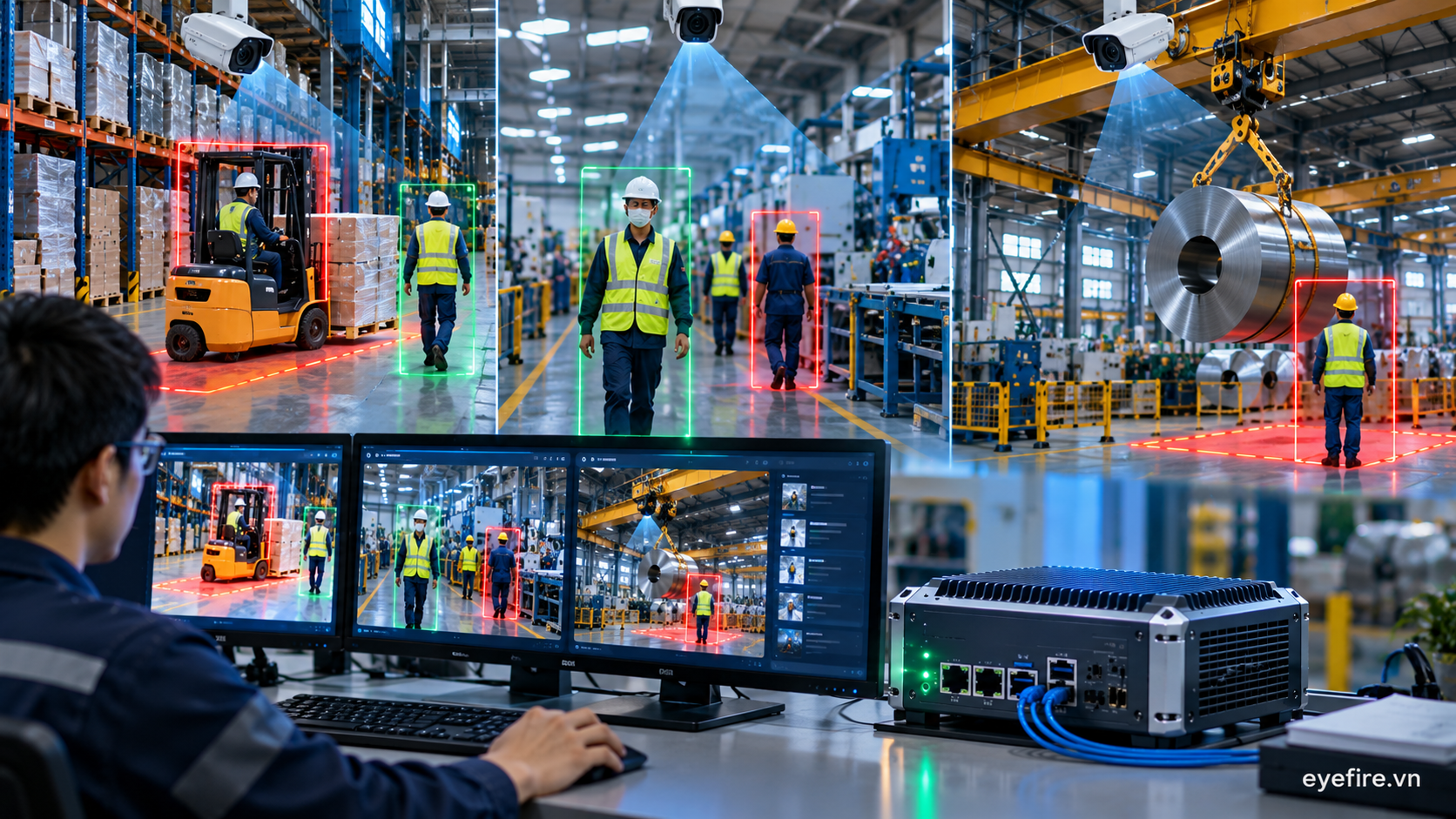
An AI Hub can continuously analyze video footage and identify predefined events, such as people entering forklift operating areas, workers failing to wear required personal protective equipment, or individuals entering hazardous zones near machinery.
When an event is detected, the system can generate an alert so that responsible personnel can quickly receive the information. This helps shift surveillance from primarily reviewing footage after incidents to supporting risk identification as soon as abnormal conditions appear.
However, an AI Hub can only analyze what cameras capture and the types of events that its AI models are designed to recognize. The technology cannot completely eliminate false alarms or missed detections.
Supporting Monitoring Across Multiple Areas Through a Centralized Processing System
Factories often have multiple monitoring areas with different risk characteristics. Warehouses require attention to forklift operations, production lines need PPE compliance monitoring, while overhead crane and industrial machinery areas require hazardous zone monitoring.
Depending on its processing capacity and system architecture, an AI Hub can receive video streams from multiple cameras and apply suitable analytics functions to each area.
Organizing monitoring through a shared processing system can make it easier for businesses to manage AI Vision applications rather than deploying completely separate solutions.
Nevertheless, the number of cameras that can be processed simultaneously does not depend solely on the number of connection ports. Businesses must consider video resolution, the number of frames analyzed per second, AI model complexity, and hardware processing capacity.
Providing Data for Continuous Safety Improvement
The value of an AI Hub goes beyond detecting individual abnormal events. When integrated with suitable management software, event data can also help businesses analyze recurring safety issues during daily operations.
For example, if alerts involving pedestrians and forklifts repeatedly occur at the same intersection, the EHS department can review internal traffic arrangements or measures for separating pedestrians and vehicles.
Similarly, if PPE non-compliance frequently occurs in a particular area, businesses can reassess working procedures, training activities, or on-site inspection methods.
In this way, data from AI Camera systems can support informed decision-making rather than being used solely to record individual events.
How Is an AI Hub Different from an AI Camera and an NVR?
AI Hubs, AI Cameras, and Network Video Recorders (NVRs) can all be part of a surveillance system, but they serve different purposes.
AI Camera refers to a camera with built-in image analytics capabilities. Depending on the product, the camera can perform certain recognition and event detection functions directly on the device without transferring the entire analysis process to an external processor.
AI Hub focuses on receiving and analyzing video data from cameras or other supported image sources. This model is worth considering when businesses want to add AI capabilities to existing camera systems or organize centralized processing for multiple video streams.
Network Video Recorder (NVR) primarily receives, records, stores, and plays back video from IP cameras. Some modern NVRs also integrate AI functions, meaning the boundaries between these device categories may vary depending on the product.
The important consideration is not choosing equipment based on its name, but clearly identifying the functions the system needs to perform: recording, AI analysis, event detection, alerting, or data management.
In many cases, an AI Hub and an NVR can operate together, with one system handling video storage and the other performing AI analysis.
Applications of AI Hubs in Factory Safety Monitoring
Forklift Safety Monitoring
In warehouses and logistics centers, forklifts frequently operate in areas where pedestrians, goods, and material-handling equipment move simultaneously.
When deployed with suitable AI models, an AI Hub can analyze camera footage to detect people or forklifts appearing in designated monitoring areas, helping identify situations where their movement paths may intersect.
Alert data can help responsible departments identify locations where risks frequently occur and consider adjustments to internal traffic arrangements.
Personal Protective Equipment Monitoring
In production areas where PPE is required, an AI Hub can analyze video footage to identify workers who are not wearing safety helmets, reflective vests, or other protective equipment supported by the AI model.
When suspected non-compliance is detected, the system generates an alert so that responsible personnel can verify the situation and request corrective action when necessary.
This application can help businesses strengthen monitoring in areas with large workforces or multiple shifts, but it does not completely replace on-site safety inspections and management activities.
Hazardous Zone Monitoring for Overhead Cranes and Machinery
In steel factories, mechanical engineering facilities, and other heavy industrial manufacturing environments, the operating areas of overhead cranes, stamping machines, and lifting equipment can present serious safety risks.
An AI Hub can receive footage from cameras installed in designated monitoring areas, analyze the presence of people, and help detect entry into hazardous zones according to predefined conditions.
For overhead cranes in particular, the location of hazardous zones may change as suspended loads move. Therefore, detection effectiveness depends on camera placement, monitoring zone configuration, and the AI model's processing capabilities.
AI Cameras and AI Hubs should only be considered supplementary monitoring layers. Mandatory machinery safety functions must still be performed by dedicated protective systems that meet applicable technical requirements and standards.
Key Factors to Consider Before Deploying an AI Hub
Before investing in an AI Hub, businesses should evaluate both their existing camera infrastructure and their actual safety monitoring requirements.
The first consideration is compatibility with IP cameras. Businesses need to determine whether their cameras provide suitable video streams, whether the network infrastructure can meet data transmission requirements, and whether the devices can integrate with the intended AI analytics platform.
The next factor is image quality and camera placement. A high-resolution camera does not necessarily provide suitable footage for AI analysis if the monitored objects appear too small, are obstructed, or are captured from unfavorable viewing angles.
In addition, the AI Hub's processing capacity must be evaluated based on the number of cameras, types of AI models, analysis speed, and alert latency requirements. A system suitable for a few cameras performing simple monitoring tasks may not be capable of handling multiple high-resolution video streams with complex AI workloads.
Businesses should also consider alert integration, security, and system operation. Important aspects include access permissions, video data protection, integration with existing management systems, network failure handling, and maintenance procedures.
Finally, pilot testing should be conducted in representative areas before expanding deployment. The testing process should evaluate detection recall, false alarm rates, alert latency, and the effectiveness of coordination between the AI system and responsible personnel.
How Does EYEFIRE Use AI Hubs in Factory Safety Monitoring?
EYEFIRE develops AI Camera and AI Vision solutions to help businesses detect abnormal situations early in industrial environments. One deployment approach involves combining cameras with AI processing systems to analyze footage and generate alerts based on configured monitoring conditions.
For example, in an overhead crane safety monitoring solution deployed at a steel coil processing factory, the system uses four cameras positioned in different directions and moving together with the overhead crane to observe the area beneath suspended loads.
Video data is transmitted to an AI Hub for analysis, helping detect people entering hazardous zones and generating alerts according to predefined conditions. This deployment approach adds risk detection capabilities in areas that are difficult to monitor continuously through human observation.
In addition to overhead crane monitoring, EYEFIRE's AI Vision solutions address applications such as forklift safety, PPE monitoring, and detecting people entering hazardous areas.
For businesses with existing CCTV systems, adding an AI Hub may be an option worth considering to make use of their current camera infrastructure. However, integration capabilities and the scope of supported functions must be determined through technical assessments and the specific requirements of each factory.
More importantly, an AI Hub does more than enable cameras to recognize additional events. It also provides a foundation for connecting surveillance activities with alert handling procedures, risk response, and continuous safety improvement.
Conclusion
AI Hubs play an important role in adding AI-powered video analytics capabilities to factory safety monitoring systems. By receiving camera data, detecting abnormal events, and supporting alert generation, AI Hubs help businesses make better use of the video data they already capture every day.
However, deployment effectiveness depends not only on AI processing hardware but also on camera quality, network infrastructure, recognition models, and the response procedures followed by on-site personnel.
The value of an AI Hub is not determined by how many video streams it can process, but by its ability to transform camera footage into useful information that helps businesses detect risks earlier and manage safety more effectively.